Instead of rebuilding your stretching plan every evening, organize HYROX taper week mobility around familiar Pliability routines, your reduced training schedule, and a separate race-day warm-up. This 2026 workflow keeps mobility supportive: maintain comfortable movement without turning recovery into another hard session.
- Pliability suits HYROX athletes who want guided mobility videos alongside an existing taper plan.
- HYROX taper week mobility should prioritize familiar movement, not deeper stretches or new personal records.
- Keep recovery stretching separate from your progressive, movement-specific race warm-up.
- Stop movements that cause pain; persistent or worsening symptoms need professional assessment.
Why this matters
HYROX combines 8 runs of 1 kilometer with 8 workout stations. Your ankles, hips, and shoulders must handle different positions repeatedly, but race week is not the time to force a new range of motion.
Pliability is best suited to HYROX athletes who want guided mobility routines alongside an existing training plan. The Pliability mobility app provides daily stretching and recovery videos; use that guidance to support your taper, not replace race programming or injury assessment.
The useful distinction is between maintaining movement and chasing improvement. A session that feels demanding, introduces unfamiliar positions, or leaves you sore does not serve the same purpose as an easy recovery routine.
For your 2026 race week, keep the goal simple: arrive with familiar movement available and no extra fatigue from mobility work. Judge each session by how you move afterward, not how far you stretch during it.
Before you start
- Access and space: Have access to the app, a device that plays its videos, and enough clear floor space to follow your chosen routine safely. Preview any equipment requirements before starting.
- A real taper schedule: Keep your coach's training plan or your established race-week schedule beside you. Mobility fits around reduced training; it does not decide how much running or station work you should do.
- The non-obvious gotcha: A daily video is not automatically the right race-week session. Preview the movements and demands rather than assuming you should complete a routine because it appears that day.
If you have an injury, a recent procedure, or symptoms that change your gait, follow your clinician's restrictions. A general mobility video does not override those instructions.
Your race-week schedule
Set the purpose before choosing the video
- Mark race day. Put the event in your calendar and work backward through the surrounding week. Use your actual travel and training commitments, not an ideal schedule you cannot follow.
- Add training first. Record the reduced sessions already in your taper plan. Do not add hard station practice simply to check whether stretching has improved your movement.
- Identify easy recovery windows. Place mobility where you can move without rushing and where it will not displace sleep, meals, or essential race preparation.
- Give each session a purpose. Write a short intention such as comfortable ankle movement, relaxed hips, or easy upper-body movement. Avoid goals such as deepest squat or maximum stretch.
Expected result: Your calendar shows where mobility belongs and why it is there. No session exists simply to fill an empty evening.
For a 2026 race-week calendar, use plain labels: training, recovery mobility, travel, and race warm-up. These labels describe your plan; they are not app settings or a required software connection.
This is a manual planning workflow, not an automated integration between the app and your race calendar. Its advantage is control: you decide whether a routine matches that day's needs. Its limitation is the same—you must review the choice rather than follow it automatically.
Match the session to the day
Use this distinction before selecting a routine. Recovery mobility and a race warm-up have different jobs; neither is a substitute for the other.
| Approach | Best for | What it contributes | Limitation |
|---|---|---|---|
| Familiar recovery mobility | Easy movement away from the start line | Guided attention to comfortable positions and movement | Does not replace progressive race preparation |
| Progressive race warm-up | Preparing immediately before racing | A gradual transition toward running and station demands | Is not the place for an extended recovery session |
Recommendation: keep both roles distinct. Choose recovery work because it leaves you comfortable, and choose warm-up movements because they prepare you for the effort ahead.
Your routine selection
Choose familiar movement
- Review a routine you already know. Start with a video you have completed comfortably during normal training. Familiarity matters more than finding a new routine with a race-related title.
- Preview the full sequence. Check the positions, transitions, and any equipment before committing. Reject a sequence that introduces an unfamiliar demand during taper week.
- Match the focus to ordinary stiffness. If your ankles feel restricted after sitting, prioritize comfortable ankle movement. If your shoulders feel stiff, choose familiar upper-body work rather than repeating every lower-body stretch you know.
- Keep the effort easy. Use a range you can control while breathing normally. Do not force depth, bounce into a position, or turn a supported stretch into a strength challenge.
- Set a stop rule. Stop a movement if it causes sharp pain, tingling, numbness, or increasing discomfort. Do not use the video's remaining runtime as a reason to continue.
Expected result: You have a familiar routine with a clear purpose and an effort level that does not compete with your taper.
Pliability mobility videos provide structure, but the video cannot assess your symptoms. The practical benefit is less decision-making once you have chosen a suitable routine; the limitation is that general guidance cannot determine why a joint hurts.
For broader training context outside race week, use the mobility training for HYROX competitors guide. Build unfamiliar movements into normal training rather than using taper week as a testing window.
Check your response without testing your limits
Choose a comfortable everyday movement before the session, then repeat it afterward under similar conditions. An easy squat, an unloaded overhead reach, or a short walk can help you notice whether the session left you more comfortable or more irritated.
Do not turn that check into a performance test. Use the same stance, support, and effort each time; otherwise, a deeper position tells you little about what changed.
A useful note records the response, not a score: comfortable, unchanged, or irritated. There is no need to invent a readiness percentage or chase a new range-of-motion number in 2026.
Your session check
Complete the recovery loop
- Check your starting state. Notice ordinary stiffness, unusual soreness, and any pain before pressing play. Skip the planned routine if your symptoms conflict with the movements it requires.
- Follow with control. Move into positions gradually. Reduce the range or stop when you cannot maintain comfortable breathing and control.
- Repeat the easy movement check. Compare comfort with your starting state. Do not push harder to make the result look better.
- Record the response. Note whether you felt comfortable immediately afterward and how you felt the next morning. Use that response when deciding whether to repeat the routine.
- Keep or remove the session. Retain familiar work that feels comfortable. Remove movements that repeatedly produce soreness or irritation rather than trying to stretch through the reaction.
Expected result: Your next session follows your response, not a completion streak. A skipped routine is preferable to an unnecessary aggravation before racing.
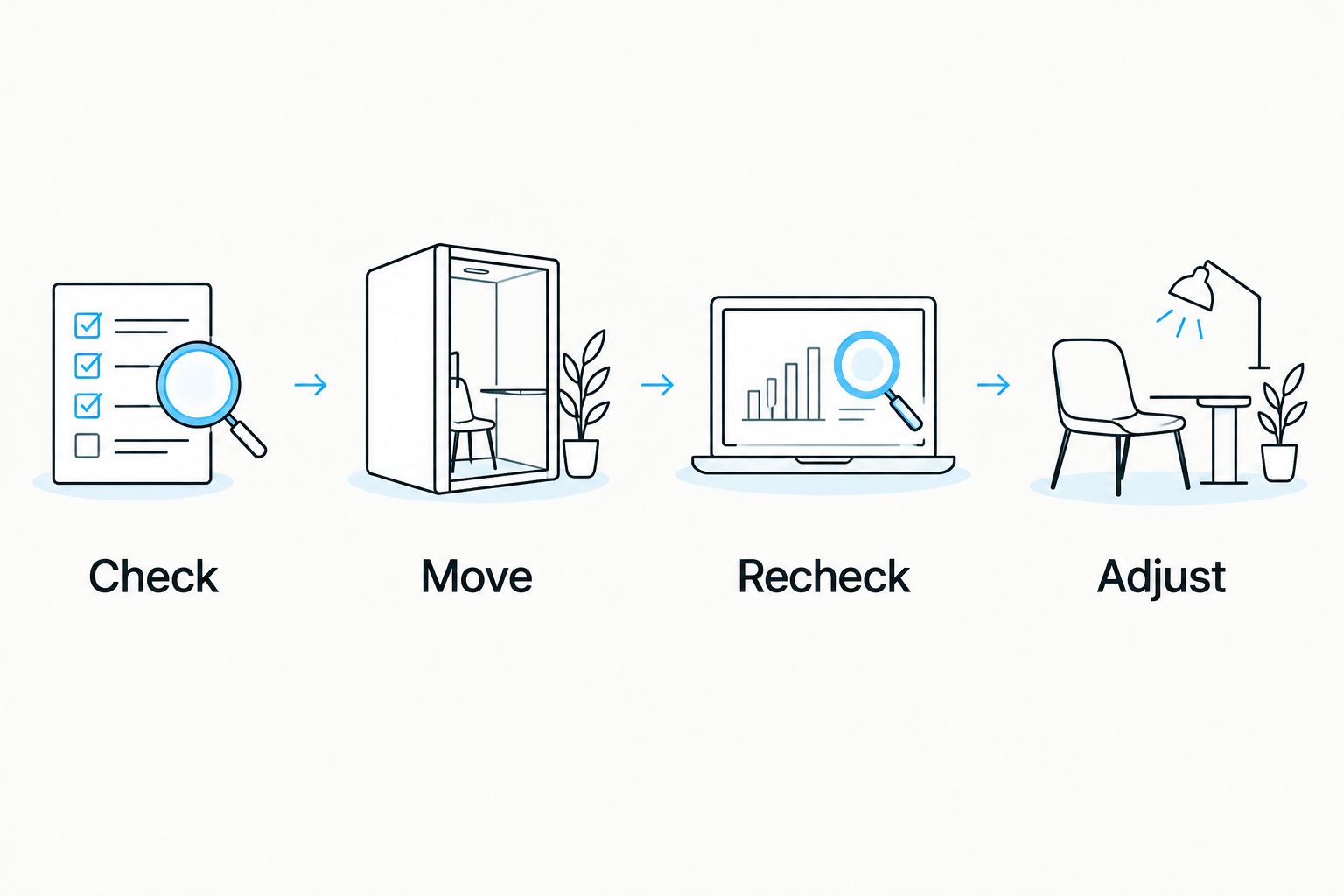
The decision sequence is deliberately short: check, move, recheck, and adjust. Keep it consistent throughout your 2026 taper so that you are not changing the routine and the evaluation method at the same time.
A comfortable session does not create an obligation to do more. Finish when the planned recovery work is complete, even if you feel capable of adding another routine.
Variant: adapt the workflow after travel
Travel changes the setting, not the goal. If you arrive feeling stiff, use the same familiar-movement process rather than compensating with a harder or longer stretching session.
- Walk and settle first. Give yourself a chance to move normally after sitting before deciding that every tight sensation needs stretching.
- Check the space. Confirm that the floor, available support, and room around you suit the movements. Do not improvise unstable supports to reproduce a routine exactly.
- Choose familiar, comfortable work. Use the routine only if its positions fit both your body and the space. Leave out a movement rather than force the setup.
- Recheck comfort. Stop adding work when ordinary movement feels comfortable. Protect your planned rest instead of trying to erase every sensation of stiffness.
Expected result: Travel-day mobility remains easy recovery rather than an extra workout squeezed into a hotel room.
On race morning, switch purposes. Follow your practiced progressive warm-up, moving toward the demands of running and the stations. Do not treat a long floor-based recovery routine as your complete start-line preparation.
Troubleshooting
You feel more sore the next morning
Remove the routine or movement that preceded the reaction and review what changed. Unfamiliar positions, excessive effort, and forcing range are reasons to simplify, not add another recovery session.
If soreness changes how you walk or perform ordinary movements, seek qualified advice before racing. Do not use stretching to prove that the symptom is harmless.
A stretch produces pinching, tingling, or numbness
Stop that movement. Reduce neither the problem to ordinary tightness nor the response to a challenge you should tolerate.
If the symptom persists, recurs, or worsens, get professional assessment. A different video is not a diagnosis.
The daily routine does not fit your taper
Choose previously comfortable work instead, or skip the session. Daily content is an option, not an instruction to accept every movement during race week.
Keep your taper plan in charge. You do not need to complete a new routine to benefit from an established mobility habit.
You finish stretching but still feel unprepared to race
Use your practiced race warm-up. Recovery stretching and preparation for hard effort are different tasks, so completing the former does not establish readiness for the latter.
If the issue is pain, illness, or unusual weakness rather than a lack of warm-up, seek appropriate medical advice instead of adding intensity.
Customize your workflow
Make the system smaller before making it more elaborate. Keep a short note with the routine you used, its purpose, and your response; avoid building a dashboard you will not maintain.
For athletes working with a coach, share the actual movements rather than reporting only that you did recovery. That makes it easier to identify overlap with training and remove unnecessary work.
After the event, review which routines felt useful without causing irritation. Use those observations to shape normal training, when you have room to introduce and evaluate new movements gradually. Keep the 2026 race-week version conservative and familiar.
FAQ
What is the best approach to HYROX taper week mobility?
Use familiar, comfortable mobility that supports your existing taper without adding fatigue or soreness. Keep recovery routines separate from your progressive race-day warm-up.
Can I use Pliability during HYROX race week?
Yes, use Pliability for familiar guided mobility alongside your established taper plan. Preview the routine and stop movements that cause pain or increasing discomfort.
Should I stretch more because my training volume is lower?
No, reduced training does not create a requirement for extra stretching. Choose mobility according to comfort and purpose rather than filling the time left by shorter workouts.
Should I try a new mobility routine before my HYROX race?
Keep unfamiliar routines out of race week. Introduce and assess new movements during normal training instead of testing your response immediately before an event.
Does recovery stretching replace my HYROX warm-up?
No, recovery stretching does not replace a progressive, movement-specific warm-up. Use the preparation you have practiced for running and station work.
What should I do if mobility makes my hips or ankles hurt?
Stop the movement that causes pain rather than forcing more range. Persistent, recurring, or worsening symptoms need professional assessment, particularly if they change how you walk.
How do I know whether my taper mobility routine is helping?
Compare a comfortable everyday movement before and after the routine, then notice your next-morning response. Keep work that feels comfortable and remove movements that repeatedly cause irritation.
One last thing
A better-looking stretch is not the goal of race week. A deeper position after a session does not, by itself, prove that you are better prepared to race.
Keep the recommendation practical: finish with comfortable movement, preserve your planned rest, and resist adding work just because the taper feels quieter than normal training.