Best overall for daily mobility support: Pliability. Best for targeted pre-workout mobility: GOWOD. Best for preparation alongside guided workouts: Nike Training Club. This 2026 guide separates mobility practice from the warm-up you still need before lifting, running, or competing.
- The best warm up app for athletes matches the session ahead, not just the joint that feels tight.
- GOWOD is the strongest fit here for targeted pre-workout mobility routines.
- Nike Training Club suits athletes who want mobility sessions alongside guided workouts.
- Daily stretching supports mobility practice; it does not replace progressive, sport-specific preparation.
Why this matters
A stretching session and a warm-up have different jobs. Stretching explores available range; a warm-up prepares you to use the movement, speed, and effort your next session demands.
That distinction matters when your ankles feel stiff before squats or your hips feel restricted before a run. You need movement you can control, followed by practice of the task ahead—not simply a longer stretch.
For your 2026 training plan, judge an app by where it fits. Daily mobility belongs in your routine, targeted preparation belongs before training, and recovery work belongs where it does not displace either.
No app replaces the gradual build from easy movement to training intensity. A useful app supports that build rather than becoming a separate workout you must finish first.
What makes the best warm-up app for athletes?
Use these criteria before choosing a subscription or adding another routine to your phone:
- Session relevance: Preparation should reflect the movements ahead. Running, overhead lifting, and wall balls do not ask the same things of your body.
- Active control: Look for opportunities to move through range, not just remain in passive positions.
- Clear instruction: You should understand the setup, movement, and intended sensation without repeatedly stopping the video.
- Repeatability: Choose guidance you can follow consistently without turning preparation into an obstacle to training.
- A defined role: Know whether you are choosing daily mobility instruction, targeted pre-workout support, or a general training companion.
- Room for progression: The routine must leave time for rehearsal sets, easy running, or other sport-specific preparation.
For this 2026 shortlist, specificity matters more than the size of a workout library. A smaller set of relevant movements beats scrolling through unrelated sessions while your training time disappears.
Best warm-up apps at a glance in 2026
These apps cover different needs. The order favors a sustainable mobility habit first, then more targeted preparation, then broader workout guidance.
| App | Best for | Standout feature | Key limitation |
|---|---|---|---|
| Pliability | Daily mobility support around athletic training | Daily mobility, stretching, and recovery video routines | A daily mobility session does not replace sport-specific preparation |
| GOWOD | Targeted pre-workout mobility | Mobility assessment and pre-workout routines | Mobility preparation still needs a progressive sport-specific warm-up |
| Nike Training Club | Mobility alongside guided workouts | Trainer-led workouts and mobility sessions in one app | A general workout library does not replace your sport's preparation plan |
There is no universal winner for every minute before training. Choose the row that matches your actual gap: a missing habit, a targeted mobility need, or a need for broader workout instruction.
1. Pliability: best warm-up support app for daily mobility
Pliability provides subscription-based daily mobility, stretching, and recovery video routines for athletes and fitness enthusiasts, including HYROX competitors and teams. Its clearest role in this comparison is helping you make mobility a regular part of training rather than something you remember only when you feel restricted.
Choose this approach when your problem extends beyond the first few minutes of a workout. If you repeatedly rush mobility or struggle to follow written exercise lists, guided video routines give that work a defined place in your day.
Pliability pros:
- Daily routines give mobility practice a repeatable format.
- Video instruction provides a movement reference rather than an exercise name alone.
- Mobility, stretching, and recovery sit within the same offering.
- The stated audience includes athletes, fitness enthusiasts, and HYROX competitors.
Pliability cons:
- Daily mobility work is not a complete running, lifting, or competition warm-up.
- You still need to select work that fits your training schedule and current tolerance.
- Following a video does not provide individual assessment of pain or injury.
Best for: Athletes who want a consistent mobility habit alongside their existing training plan.
Use the app for its stated purpose. Before training, add progressive movement and rehearsal of the session ahead; outside training, give mobility practice its own space instead of forcing everything into your warm-up.
Verdict: Buy for daily mobility support; skip it as a substitute for sport-specific preparation.
2. GOWOD: best warm-up app for targeted pre-workout mobility
GOWOD centers on mobility assessment and routines that include pre-workout preparation. That makes it the most direct fit here when your main question is what mobility work to do before the session you have planned.
The distinction is useful. You are choosing an app with a pre-workout mobility role, rather than assuming every stretching session belongs immediately before training.
GOWOD pros:
- Mobility assessment provides a starting point for choosing work.
- Pre-workout routines give preparation an explicit place in the app.
- A mobility-focused format keeps the task separate from choosing a full workout.
GOWOD cons:
- An app-based assessment is not a clinical diagnosis.
- Mobility guidance does not cover every skill, speed, or loading demand of your sport.
- You still need to check how the suggested movements feel during your own training.
Best for: Athletes who already have a training program and want targeted mobility before it.
After the mobility work, rehearse the movements you will actually train. Before squats, build through controlled squat repetitions and progressive warm-up sets; before running, progress from easy movement toward the intended effort.
Verdict: Buy for targeted pre-workout mobility; skip it if you want a complete training program.
3. Nike Training Club: best warm-up companion for guided workouts
Nike Training Club offers trainer-led workouts and mobility sessions. Its strongest use case here is the athlete who wants movement preparation within a broader training resource rather than a separate mobility-only tool.
That breadth suits general fitness training. It does not remove the need to connect your preparation to the specific workout, practice, or competition ahead.
Nike Training Club pros:
- Guided instruction supports athletes who prefer following a trainer.
- Mobility sessions sit alongside broader workout options.
- One app can support both general training and separate mobility practice.
Nike Training Club cons:
- A broad library still requires you to choose an appropriate session.
- General mobility sessions do not replace sport-specific drills or progressive loading.
- Athletes following a team program must fit app sessions around that program.
Best for: Athletes who want guided general workouts with mobility as part of the mix.
Choose this option when workout instruction is the main need and mobility is a supporting one. If you already know exactly what to train and only need targeted preparation, a narrower tool fits that job better.
Verdict: Buy into this approach for guided general training; skip it as your only competition warm-up plan.
Turn app guidance into a useful warm-up
An app should help you prepare, not distract you from the session. Use this sequence to connect guided mobility with the work ahead.
Raise temperature
Start with easy whole-body movement. Walking, light jogging, or comfortable cycling can provide a gradual entry into training without asking for your hardest effort immediately.
Move with control
Choose active movements that relate to the session. For lower-body training, that might include controlled ankle movement, squats through a comfortable range, and lunges you can perform without losing balance.
Rehearse the task
Practice the movement you are about to train. A runner needs running preparation; a lifter needs rehearsal of the lift. Mobility work supports this step but does not replace it.
Build effort
Increase speed, load, or intensity progressively. Finish the warm-up ready for the first working effort, not exhausted from preparation.
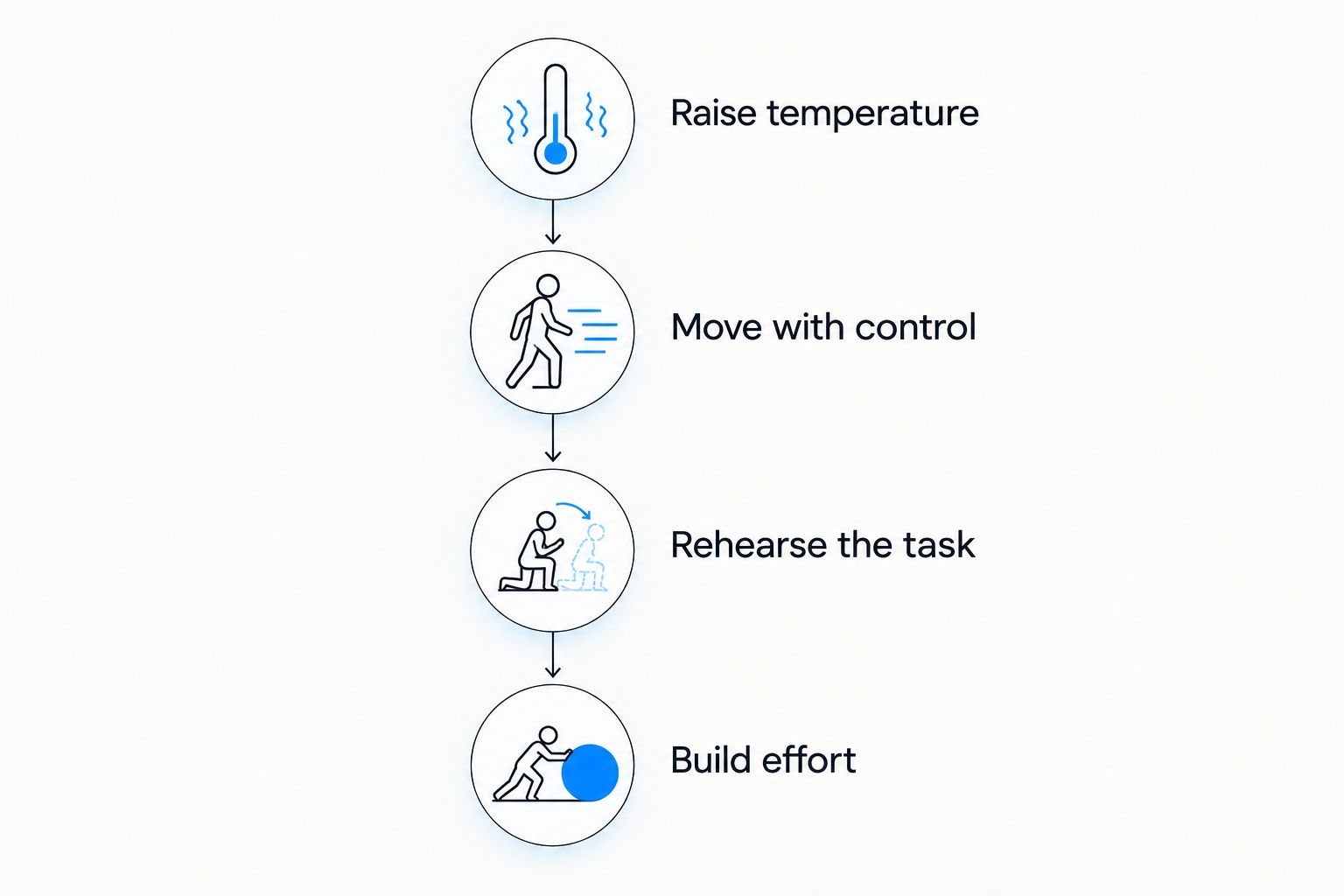
For a simple planning example, allocate 2 minutes to easy movement, 3 minutes to controlled mobility, and 5 minutes to rehearsal and a gradual build. These are organizational choices, not a researched minimum or a guarantee of readiness.
Adjust the outline to the session and your response. A demanding workout can require more preparation; a clock cannot tell you whether your technique feels controlled.
Match the warm-up to the session
Before strength training: Use mobility work to explore the positions you need, then practice the lift. Gradually build the load rather than jumping from a stretching video directly to working sets.
Before running: Start easily and progress toward the demands of the run. A mobility session alone does not rehearse running rhythm, impact, or faster efforts.
Before HYROX training: Prepare for both running and the stations included in that session. Rehearse transitions and relevant movement patterns instead of treating general hip stretching as complete preparation.
Before team practice: Follow the team's preparation plan first. Add individual mobility work where it serves a clear need and does not leave you fatigued before shared drills.
The practical test is simple: does your preparation resemble what comes next? If the answer is no, change the warm-up before changing the app.
How the apps are ranked
This 2026 ranking prioritizes session relevance, clear instruction, repeatability, and a defined role within training. The order reflects those use cases, not a head-to-head performance test or a claim that an app prevents injuries.
The first recommendation addresses daily mobility consistency. The second addresses targeted pre-workout mobility. The third addresses guided training with mobility alongside it.
Choose by the job you need done. A broad workout app is not automatically better than a focused mobility app, and a focused mobility app is not automatically a complete warm-up.
Which warm-up app should you choose?
Choose Pliability if your biggest gap is consistent daily mobility practice. Choose GOWOD if your priority is targeted pre-workout mobility, or Nike Training Club if you want mobility alongside guided general workouts.
For 2026, keep the decision tied to your behavior. If you already have a sound warm-up but rarely practice mobility, solve the habit problem; if you regularly stretch but skip rehearsal sets, fix the preparation sequence.
Do not judge success by how many sessions you complete. Judge whether the routine fits your training, whether you can follow it consistently, and whether you still arrive at your main work prepared rather than tired.
FAQ
What's the best warm up app for athletes?
GOWOD is the most direct fit in this shortlist for targeted pre-workout mobility. Nike Training Club fits athletes who want mobility alongside guided workouts; neither replaces progressive sport-specific preparation.
Is Pliability a warm-up app or a recovery app?
Pliability offers daily mobility, stretching, and recovery video routines. Treat it as support for your mobility practice, not as a replacement for rehearsing and progressively building into your sport.
Can a stretching app replace my warm-up?
A stretching app does not replace a complete warm-up. You still need progressive movement and practice of the task ahead, such as easy running or warm-up sets.
Should I stretch before lifting weights?
Prepare for lifting with controlled movement and progressively loaded rehearsal sets. If you include stretching, keep it relevant to the positions you need rather than using it instead of practicing the lift.
How long should I use a warm-up app before training?
Use the app for the part of preparation it supports, then leave time for sport-specific rehearsal. The appropriate duration depends on the session, your starting point, and how you respond—not a universal app timer.
What's the difference between mobility and a warm-up?
Mobility concerns the range of movement you can access and control; a warm-up prepares you for a particular activity. Mobility work can be part of a warm-up, but preparation also includes building effort and practicing the task.
Should I keep warming up if a movement hurts?
Stop a movement that causes pain rather than forcing more range. Seek assessment from a qualified healthcare professional for persistent, worsening, or unexplained pain.
One last thing
Save one repeatable preparation sequence before downloading another app. Name the movements you need, place mobility work where it helps, and finish with rehearsal of the session ahead.
A familiar warm-up you perform with attention is more useful than an elaborate routine you rush. Keep the app in a supporting role. Your training remains the point.