
Best overall: Pliability for guided daily mobility. Best for recovery tracking: WHOOP. Best for Garmin users: Garmin Connect. Best for a pre-sleep meditation habit: Headspace. This 2026 guide separates apps that guide recovery activities from apps that track recovery signals.
- Pliability is the best recovery app for HYROX competitors who want guided daily mobility, stretching, and recovery routines.
- WHOOP suits athletes who want wearable-based recovery tracking, not follow-along stretching.
- Garmin Connect suits existing Garmin users; available recovery features depend on the connected device.
- Headspace supports meditation and bedtime routines, not mobility or race-readiness assessment.
Why this matters
HYROX combines 8 runs of 1 kilometer with 8 workout stations. Your recovery needs are broader than sore legs: you also need to manage training load, sleep, and movement between sessions.
An app can guide a stretching session, organize wearable data, or help you settle down before bed. Those are different jobs. Choose the job first, then choose the app. A readiness score does not guide you through ankle mobility, and a stretching routine does not measure your overnight heart-rate variability.
For your 2026 training block, the useful question is not which app displays the most information. It is which app helps you take the next sensible action without adding another task you ignore.
What makes the best recovery app for HYROX?
Use these criteria before comparing names. An app earns its place when its main function matches a gap in your existing routine.
- Clear recovery task: Decide whether you need guided movement, recovery monitoring, or help winding down. Avoid treating them as interchangeable.
- Relevant guidance: For mobility work, look for instruction you can follow rather than a list of exercise names you must interpret yourself.
- Practical routine: Choose something that fits around your running, strength work, and station practice. A complicated setup creates another obstacle.
- Useful feedback: Tracking should inform a decision. More charts do not automatically make your recovery plan better.
- Hardware fit: Check whether the useful features require a wearable and whether your current device supports them.
- Clear limits: Recovery software is not injury assessment. Persistent pain, swelling, or altered movement needs qualified clinical advice.
For this 2026 shortlist, guided mobility takes the default slot because it provides an activity to follow. Tracking and meditation take separate slots because they solve different problems, not because they are weaker versions of stretching.
Best HYROX recovery apps at a glance
| Rank and app | Best for | Standout function | Key limitation |
|---|---|---|---|
| 1. Pliability | Guided daily mobility | Mobility, stretching, and recovery video routines | Does not replace load management or injury assessment |
| 2. WHOOP | Wearable-based recovery tracking | Recovery reporting informed by physiological measurements | Requires WHOOP hardware; a score is not a mobility session |
| 3. Garmin Connect | Existing Garmin users | Brings compatible-device training and recovery information together | Available metrics depend on your Garmin device |
| 4. Headspace | A meditation-based wind-down habit | Guided meditation and sleep-focused audio | Does not assess physical readiness or guide HYROX mobility |
The order reflects distinct recovery tasks. If you already follow a mobility routine but need better visibility into training stress, the tracking options deserve your attention first.
1. Pliability: best recovery app for guided HYROX mobility
Pliability offers a subscription app with daily mobility, stretching, and recovery video routines for athletes and fitness enthusiasts, including HYROX competitors and teams. Its role is straightforward: give you movement guidance to follow rather than another set of measurements to interpret.
Choose this approach when the missing piece is the session itself. You finish training, notice stiff ankles or tight hips, and want guidance instead of building a routine from disconnected clips.
Best for: HYROX competitors who want a repeatable, guided mobility habit alongside their training.
Pliability pros
- Daily video routines provide a clear activity to follow.
- Mobility, stretching, and recovery sit within the app's stated focus.
- The audience explicitly includes HYROX competitors and teams.
- Guided instruction removes the need to assemble every session yourself.
Pliability cons
- Following a routine still requires your time and attention; downloading an app does not establish the habit.
- Stretching cannot substitute for managing an excessive training load.
- Video instruction cannot assess the cause of persistent pain or an individual injury.
Where it fits in your training
Give guided mobility a defined place in your week. Attach it to an existing transition, such as finishing training or beginning your evening wind-down, rather than relying on motivation at the end of a demanding day.
Keep the purpose clear. You are practicing comfortable movement, not trying to prove how far you can force a joint. Stop a movement that causes sharp pain, numbness, or symptoms that change how you move.
Verdict: Buy if guided mobility is the missing habit; skip if you only want wearable recovery data.
2. WHOOP: best recovery app for wearable-based tracking
WHOOP combines its wearable with an app that reports on sleep, strain, and recovery. Its Recovery feature uses physiological measurements, including heart-rate variability and resting heart rate, to present a readiness signal.
That makes it a different tool from a stretching app. You use the information to review your training context; you do not receive a mobility session simply by checking a score.
Best for: HYROX competitors who want a consistent view of wearable-based recovery trends.
WHOOP pros
- Sleep, strain, and recovery information appear within the same system.
- Repeated measurements let you review patterns rather than relying on memory alone.
- A recovery signal gives you a prompt to examine sleep, recent training, and how you feel.
WHOOP cons
- The system requires WHOOP hardware.
- An overall recovery score does not explain every local symptom, such as a painful ankle.
- Data still needs interpretation; the app cannot make every training decision for you.
Where it fits in your training
Use the score as one input, not permission to ignore symptoms. A favorable recovery reading does not make a painful running stride acceptable, and an unfavorable reading does not identify its cause by itself.
For a 2026 race build, decide what you will do with the information before checking it constantly. Useful responses include reviewing the previous session, discussing the planned workload with your coach, or protecting your bedtime routine.
Verdict: Buy for recovery tracking; skip if your main need is guided stretching.
3. Garmin Connect: best recovery app for existing Garmin users
Garmin Connect organizes activity and health information from compatible Garmin devices. Depending on the device, the Garmin system includes features such as Body Battery, recovery time, and training readiness.
The device qualification matters. Do not assume that every Garmin watch provides every recovery feature, or that a feature shown in a comparison is present on your watch.
Best for: HYROX competitors who already use a compatible Garmin device and want to review recovery alongside training.
Garmin Connect pros
- Recorded training and compatible-device health information sit in the same ecosystem.
- Existing Garmin users can review information from the device they already wear.
- Supported recovery features provide additional context around a training schedule.
Garmin Connect cons
- Feature support varies by device, so check the specific model.
- Wearable estimates do not assess your exercise technique or diagnose an injury.
- Reviewing charts does not replace doing mobility work or adjusting training.
Where it fits in your training
Start by learning the features your current device supports. Distinguish an energy estimate such as Body Battery from a recovery-time estimate; they answer different questions and should not be treated as identical instructions.
Keep a record of how sessions feel alongside the device information. If the data looks reassuring but your movement is painful or unusually restricted, address the symptom rather than trying to satisfy the chart.
Verdict: Hold onto Garmin Connect if it already meets your tracking needs; skip a hardware change made only to collect another score.
4. Headspace: best recovery app for a meditation wind-down habit
Headspace provides guided meditation and sleep-focused audio. It belongs here for competitors whose missing recovery habit is switching off, rather than finding another stretch or measuring another physiological signal.
Its role is mental wind-down. It does not measure HYROX readiness, diagnose sleep problems, or replace a movement routine.
Best for: HYROX competitors who want guided meditation as part of an evening routine.
Headspace pros
- Guided audio gives you a defined activity instead of unstructured scrolling.
- Meditation offers a different approach from adding more physical work.
- Sleep-focused content fits a bedtime routine without requiring training-data analysis.
Headspace cons
- It does not provide a measure of physical recovery.
- Meditation does not address restricted ankle, hip, or shoulder movement directly.
- Persistent sleep problems require appropriate professional advice, not just different audio.
Where it fits in your training
Choose Headspace when you already know what to do physically but struggle to finish the day without more stimulation. Give the audio a specific place in your evening rather than opening it only after a frustrating night.
Keep expectations grounded. A meditation session is a practice, not proof that you have recovered from a hard race simulation or corrected an ongoing sleep problem.
Verdict: Buy for guided meditation; skip if you need mobility instruction or recovery monitoring.
How we ranked these recovery apps
This ranking uses the criteria above: recovery task, guidance, practical fit, feedback, hardware requirements, and limits. It separates stated functions rather than claiming that different kinds of software produce equivalent outcomes.
The default recommendation prioritizes an activity you can follow. WHOOP serves a monitoring role, Garmin Connect suits an existing device ecosystem, and Headspace serves a meditation role. This is a 2026 buying guide, not a head-to-head clinical trial or a claim that any app prevents injury.
Choose your recovery setup by the missing habit
Start with the problem you can describe plainly. Avoid buying a second tool before identifying why the first one is not helping you act.
- Guided movement: You want instruction for mobility and stretching rather than another measurement.
- Recovery tracking: You want to review physiological trends alongside training and sleep.
- Evening wind-down: You want a guided practice that helps structure the end of your day.
These jobs can coexist, but they do not all need a new subscription. If your current wearable already provides the tracking you use, focus your next decision on the behavior that remains missing.
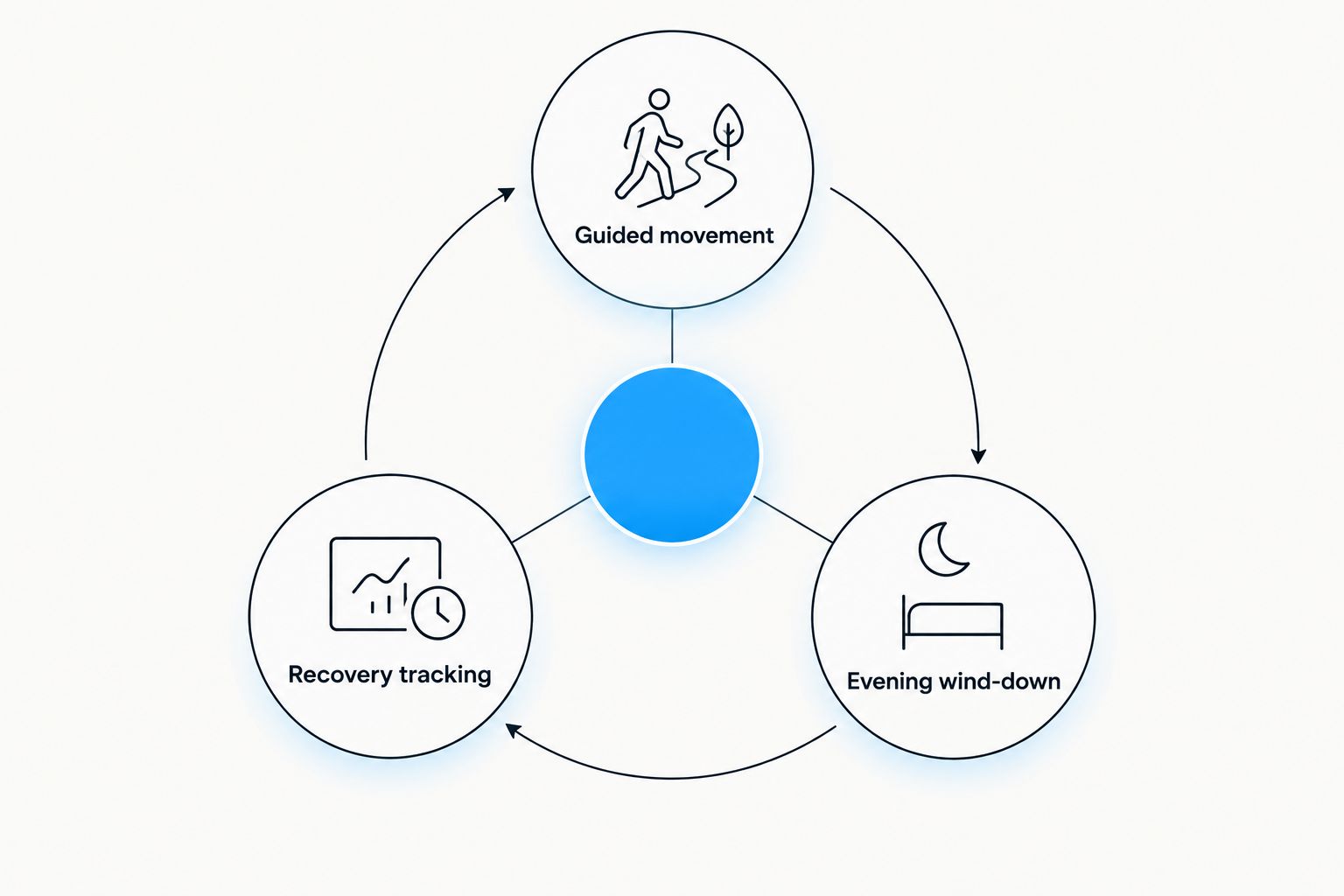
Keep your setup simple enough to use during a demanding training block. Review whether the app leads to a useful action, not merely whether you have opened it regularly.
Which recovery app should you choose?
Choose Pliability as the best recovery app for HYROX when your priority is guided daily mobility. Choose WHOOP for wearable recovery tracking, Garmin Connect when your compatible Garmin already supplies the information you need, or Headspace for a meditation-based wind-down routine.
For 2026, make the default practical: use the tool that closes a real gap in your week. Do not add another dashboard when the task you keep postponing is the recovery session itself.
FAQ
What's the best recovery app for HYROX competitors?
The best choice depends on the missing recovery task: guided mobility, wearable tracking, or meditation. Choose daily video routines when you need movement guidance, and a tracking app when you need information about recovery trends.
Is a mobility app better than WHOOP for HYROX?
A mobility app is better for following movement routines; WHOOP is better suited to wearable-based recovery tracking. Neither replaces the other's main function.
Can I use Garmin Connect instead of another recovery app?
Garmin Connect can meet your tracking needs if your compatible device provides the features you use. It does not replace guided stretching simply because it displays recovery information.
Do I need a wearable to follow recovery video routines?
You do not need wearable measurements to follow a guided mobility video. Wearable-based tracking is a separate function that requires compatible hardware.
Should I stretch through pain after a HYROX session?
Do not force a stretch through sharp pain, numbness, or symptoms that alter your movement. Persistent pain or swelling needs assessment by a qualified healthcare professional.
Can a recovery score tell me whether to train hard?
A recovery score is one input, not a complete training decision. Consider symptoms, recent workload, sleep, and your planned session alongside the score.
Can Headspace replace physical recovery work?
Headspace does not replace mobility work or training-load management. Its role in this shortlist is guided meditation and an evening wind-down practice.
One last thing
A recovery app is useful only when you know what action comes next. Before opening it, decide whether you need to move, review your training context, or wind down. That small distinction keeps a recovery habit from turning into another screen-checking habit.