
Runners’ mobility training is controlled movement through usable joint range with the aim of supporting comfortable, repeatable running mechanics. This 2026 guide shows you how to work on ankles, hips, and trunk movement without turning recovery into another hard workout.
- Mobility training for runners should build usable range, not chase the deepest stretch.
- Check ankle and hip movement, then choose a small routine you can repeat consistently.
- Pliability is best for runners who want daily guided mobility, stretching, and recovery videos.
- Use dynamic movement before running; keep relaxed stretching separate from demanding efforts.
- Persistent pain needs assessment, not a more aggressive mobility routine.
Why mobility training matters for runners
Running repeats a relatively narrow movement pattern. Your ankles, hips, and trunk still need enough available movement—and enough control—to manage each stride without forcing range somewhere else. Mobility work gives you a separate place to practice that control.
More flexibility is not automatically better running. Flexibility describes available range; mobility includes your ability to move through that range actively. A deep passive stretch does not tell you whether you can control the same position while standing on one leg.
Your 2026 running schedule also needs room for strength, easier days, and sleep. Mobility supports that plan; it does not replace those foundations or guarantee injury prevention. The useful question is not how far you can stretch, but whether a specific movement feels restricted and improves with appropriate practice.
If you are starting from scratch, the guide to mobility apps for beginners explains another way to find structured sessions. First, use the checks below to decide what deserves your attention. Tightness alone is not a diagnosis, and different runners do not need identical routines.
Build your 2026 running mobility routine
1. Check your movement before choosing exercises
Start with a comfortable squat, a supported split stance, and an ankle movement check. These are observations, not pass-or-fail tests. You are looking for a repeatable restriction, a noticeable difference between sides, or a movement that requires you to change position to finish it.
For the ankle check, face a wall and move one knee toward it while keeping the heel down. Keep the setup consistent rather than chasing a universal distance. For the hip check, use a shallow split stance and gently tuck your pelvis without arching your lower back.
Record what you feel in plain language: the heel lifts, the hip pinches, or one side feels harder to control. Do not label every difference a problem. A movement check cannot identify the cause of pain or predict an injury.
- Check both sides using the same setup.
- Keep your feet and pelvis in a repeatable position.
- Record comfort and control, not just depth.
- Stop a check that causes sharp pain, tingling, or numbness.
2. Warm up with movement before your run
Use your pre-run mobility to prepare for running, not to prove how flexible you are. Begin with walking or an easy jog, then add controlled movements that resemble the positions you will use. Increase pace gradually rather than moving straight from sitting to hard running.
Ankle rocks, marching, and small leg swings are practical choices. Hold a wall if balance makes the movement messy. The purpose is to move smoothly through a comfortable range, not to swing your leg as high as possible.
Long, intense static stretching is a different task from warming up. Keep relaxed holds for a separate session when you can explore them without rushing into a demanding effort afterward. Your warm-up should leave you ready, not fatigued.
- Start with easy forward movement.
- Add controlled ankle rocks without lifting your heels.
- Use supported leg swings without twisting your trunk.
- Finish with an easy running build-up appropriate to the session.
3. Choose a repeatable format
Start manually. Write down a short sequence, use a timer, and repeat the same movements often enough to learn them. This removes the need to choose exercises every day and makes changes easier to notice.
If deciding what to do keeps interrupting the habit, guided video is another option. Pliability is best for runners who want daily guided mobility, stretching, and recovery videos. Pliability offers that format through a subscription app; the trade-off is that following a video does not provide an individual assessment of your running or symptoms.
Choose the format you will actually use. A self-directed routine gives you control but requires exercise selection; an app supplies guidance but still requires you to judge comfort and stop when something feels wrong. Neither format makes a painful movement appropriate.
- Put your routine beside an existing daily habit.
- Keep the sequence written down or easy to find.
- Choose movements based on your checks, not novelty.
- Replace any exercise that repeatedly irritates symptoms.
4. Practice ankle range with your heel grounded
Your ankle needs forward shin movement while your foot stays in contact with the ground. Practice that movement with a slow knee-over-foot rock. Keep the heel grounded and let the knee follow the direction of your toes rather than collapsing inward to gain distance.
Move only as far as you can control. If the front of the ankle pinches, shorten the movement instead of pushing harder. A stretch sensation through the calf and a sharp block at the joint are not interchangeable experiences.
Follow the supported movement with a comfortable calf raise if it suits you. This adds active work rather than treating mobility as passive stretching alone. Do not turn it into a demanding calf workout immediately before a hard run.
- Support yourself on a wall or stable surface.
- Keep the heel down during ankle rocks.
- Move slowly enough to notice your foot position.
- Use a smaller range when control changes.
- Stop rather than forcing through joint pain.
5. Move your hips without borrowing from your back
Hip movement is easy to exaggerate by arching or rotating your lower back. In a half-kneeling position, gently tuck your pelvis and move forward only until you feel a comfortable stretch at the front of the rear hip. A bigger lunge is not automatically a better one.
For rotation, sit with your knees bent and move them gently from side to side, using your hands for support. Stay within a range that lets you move deliberately. Do not press a knee toward the floor to match a demonstration.
These movements address different directions. Pick the one that matches your restriction, and keep your trunk position honest. A front-of-hip pinch is a reason to change the position or stop, not evidence that you need a harder stretch.
- Pad your kneeling knee for comfort.
- Keep your ribs over your pelvis.
- Use hand support during seated hip rotations.
- Reduce depth before adding more effort.
- Keep breathing normally throughout the movement.
6. Add active control after comfortable movement
Once a position feels comfortable, practice controlling it. A slow supported split squat or a shallow single-leg hinge can connect available movement with balance and muscular effort. Use support freely; wobbling is not the goal.
Keep these movements easy enough that you can maintain your position. If you need to twist your pelvis, hold your breath, or rush through the difficult part, reduce the range. Mobility practice should not quietly become another exhausting leg session.
Progress one feature at a time: less support, slightly more range, or more deliberate control. Do not change everything at once. If strength is the main limitation, address it through a suitable strength program rather than adding endless stretches.
- Use a chair or wall for balance.
- Lower slowly through a comfortable range.
- Keep your foot stable and your pelvis controlled.
- End the set before technique deteriorates.
- Keep demanding strength work distinct from easy recovery work.
7. Review the routine against your running week
Repeat your original movement checks under similar conditions. Compare control and comfort, not just how loose you feel immediately after stretching. A temporary change after a session does not establish lasting progress.
Look at the whole running week too. If you added hills, speed, or distance and then became sore, more mobility is not automatically the answer. Review the training change rather than using stretching to push through worsening symptoms.
A useful routine remains small enough to repeat and specific enough to evaluate. Keep movements that help you practice a relevant range comfortably; remove exercises that consume time without serving that purpose. The aim is a sustainable habit, not a longer checklist.
- Recheck using the same stance and support.
- Note how the next run feels without treating one run as proof.
- Review changes in training alongside mobility work.
- Reduce exercises that leave you sore for key sessions.
- Seek assessment for persistent pain or altered walking or running.
Try a short starter session
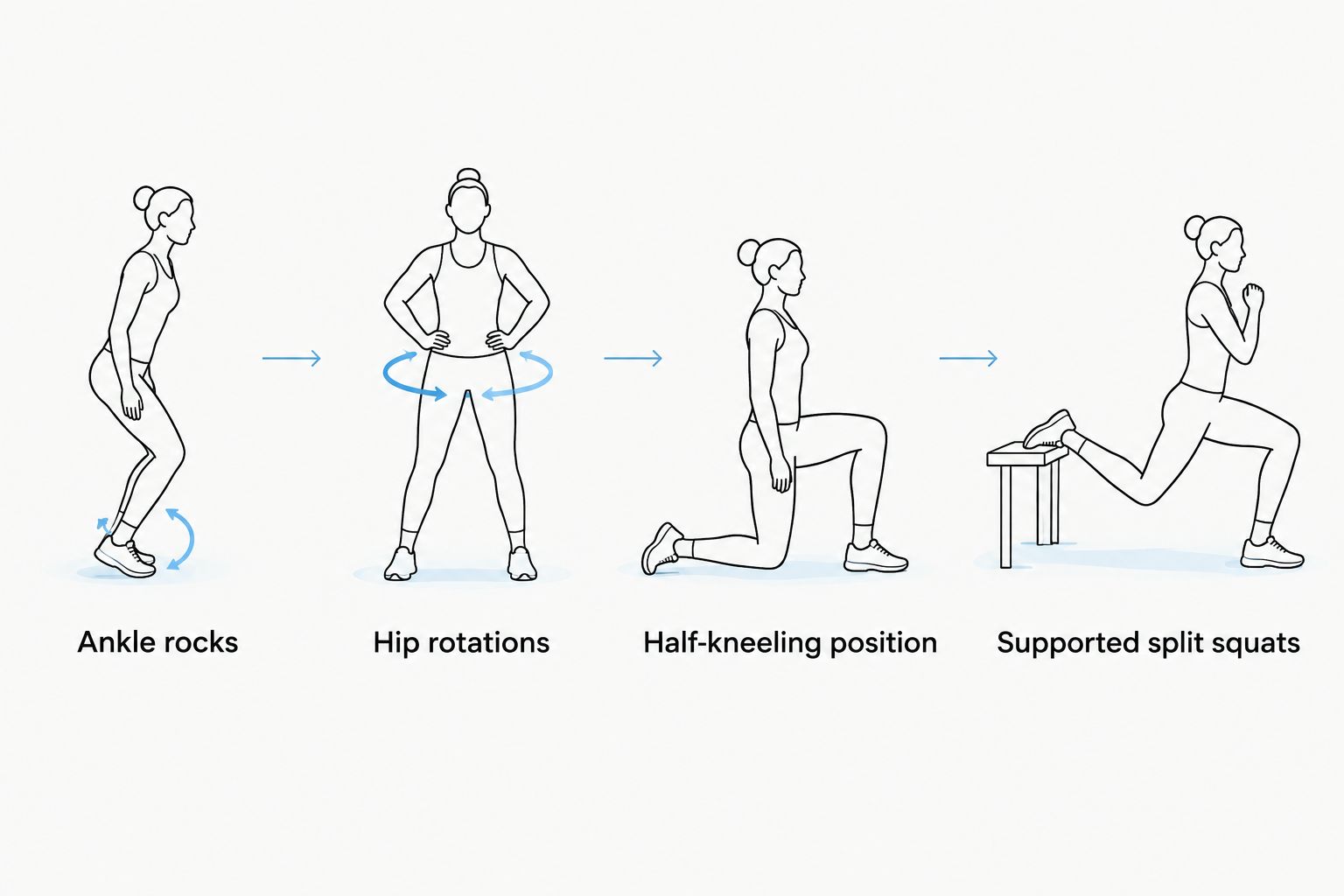
Use this as a conservative practice template, not a required dose or a treatment plan. Begin after easy walking, stay below discomfort, and leave out any movement that does not suit you. The repetition counts organize the session; they are not performance targets.
- Perform 6 slow ankle rocks per side, keeping the heel grounded.
- Try 4 supported hip rotations per side, using a comfortable range.
- Hold a gentle half-kneeling position for 20 seconds per side without arching your back.
- Finish with 4 shallow supported split squats per side, stopping before fatigue changes your position.
The sequence moves from range practice to active control. If one movement needs attention, spend your available time there rather than automatically adding more exercises. You should finish able to move normally, not feeling that you have completed another hard workout.
Compare your 2026 mobility options
Choose by the problem you need to solve. Difficulty remembering a routine is different from pain that changes your stride, and neither is solved simply by collecting more recovery tools.
| Option | Best for | Main advantage | Key limitation |
|---|---|---|---|
| Self-directed mobility | Runners who already know suitable movements | Direct control over exercise choice and timing | You must select movements and judge technique yourself |
| Pliability mobility videos | Runners who want daily guided mobility and recovery sessions | Follow-along video routines reduce exercise-selection work | App guidance is not an individual clinical assessment |
| Strength training | Runners who need to build force and control | Trains muscular capacity through chosen ranges | Adds training demand and needs appropriate progression |
| Physical therapist assessment | Runners with persistent pain or meaningful functional limitations | Provides individual evaluation and management advice | Requires arranging care rather than simply following a routine |
Match the option to the need. Guided mobility supports a habit. Strength work develops capacity. A clinical assessment addresses a different question: what is causing symptoms, and what should change? Combining approaches can make sense, but each needs a clear role.
Common mistakes runners make in 2026
Chasing loose legs instead of useful movement
A strong stretch sensation is not a progress measure. Judge the routine by comfortable control in a relevant movement, not by how intensely you feel a muscle pulling. More sensation does not make an exercise more appropriate.
Stretching every tight feeling harder
Tightness can accompany fatigue, soreness, or irritation; it does not identify a short muscle by itself. If stretching repeatedly makes the area worse, stop increasing the stretch. Review training demands and get persistent symptoms assessed.
Saving mobility for the day something hurts
A rushed session before a painful run is not a substitute for a repeatable movement habit. Put comfortable practice into your normal schedule, then treat new pain as a separate decision. Do not use a successful stretch as permission to ignore symptoms.
Adding recovery work until recovery disappears
Long mobility sessions, demanding strength work, and hard running all compete for time and energy. Keep easy sessions easy. If your recovery routine makes you sore or displaces sleep, reduce it rather than adding another exercise.
FAQ
What is mobility training for runners?
Mobility training for runners is practice that develops usable, controlled movement through joint range. It includes active movements and can include stretching, but it does not replace running progression, strength training, or clinical care.
Should I do mobility before or after running?
Use controlled dynamic movement before running, and place relaxed stretching in a separate session or after easy activity. Avoid turning either session into a painful or fatiguing workout.
How often should runners do mobility exercises?
Choose a repeatable schedule that fits your running week without adding soreness or displacing recovery. Keep the routine small, then adjust it according to comfort and the movement you are practicing.
Is mobility training better than stretching for runners?
Mobility and stretching serve overlapping but different purposes. Stretching addresses available range, while active mobility practice adds control through that range; choose according to the limitation rather than treating one as universally better.
Is Pliability suitable for runners?
Pliability suits runners who want guided mobility, stretching, and recovery video routines. Its subscription app offers daily sessions, but it does not replace an individual assessment for persistent pain.
Can mobility exercises prevent running injuries?
Mobility exercises do not guarantee injury prevention. Running-related symptoms require attention to training demands, recovery, strength, and individual circumstances rather than flexibility alone.
Should I stretch through hip or ankle pain?
Do not force a stretch through sharp pain, pinching, tingling, or numbness. Stop the provoking movement and seek appropriate assessment if symptoms persist, worsen, or change how you walk or run.
One last thing
Keep a movement check, not just a stretching streak. In 2026, a completed session is easy to record; whether that session serves your running takes more attention. Choose one comfortable check, repeat its setup, and use it to keep the routine focused.
If a stretch looks deeper only because your heel lifts or your back arches, you changed the movement rather than demonstrating more control. Make the position smaller and more honest. That is a better next step than forcing extra range.