
Golfers’ mobility training is controlled movement through usable joint range, with the aim of building a comfortable, repeatable swing. This 2026 guide covers hip rotation, upper-back movement, shoulder control, and a practical routine that fits around practice and rounds.
- Mobility training for golfers should build controlled hip rotation, upper-back movement, and shoulder range—not force a longer backswing.
- Pliability is best for golfers who want guided daily mobility videos rather than building every session themselves.
- Use active movement before golf; keep longer, comfortable stretching separate from your immediate swing preparation.
- Track movement comfort and control. A mobility session does not replace swing coaching or assessment of persistent pain.
Golf asks you to turn while maintaining posture, then transfer pressure and finish in balance. Your routine should prepare those tasks, not chase the deepest stretch you can tolerate. If you want help choosing a guided format, compare mobility apps for golfers after identifying what you need to work on.
Why mobility training matters for golfers
A golf swing combines movement at the hips, trunk, shoulders, and ankles. Mobility training gives you a separate place to practice those movements slowly, without also trying to strike a ball.
More range is not automatically a better swing. You need access to useful positions and control within them. Flexibility describes available range; mobility training adds active movement and control rather than relying only on passive stretching.
Golfers also need to distinguish preparation from practice. A pre-round warm-up prepares you to move now. A separate mobility session gives you time to explore stiffness, work both sides, and develop a repeatable habit.
For your 2026 golf plan, keep the jobs clear: mobility work develops movement options, strength training develops force capacity, and swing coaching addresses technique. None replaces the others. Persistent pain belongs with a qualified healthcare professional, not a more aggressive stretching routine.
How to build a golf mobility routine
1. Check your movement before choosing stretches
Start with simple observations at home. Move slowly through a comfortable standing turn, a supported squat, and an overhead reach. Notice where movement feels restricted and whether you compensate by arching your back, lifting a heel, or holding your breath.
These observations are not diagnostic tests. They help you choose a starting point and describe what you feel. Do not turn a difference between sides into a diagnosis or assume it explains a missed shot.
Record a short baseline for your 2026 practice plan. Use the same setup when you revisit it, rather than comparing unrelated positions or testing immediately after an unusually tiring round.
- Turn gently in both directions with your feet planted comfortably.
- Squat toward a chair and note heel lift or discomfort.
- Raise your arms without deliberately arching your lower back.
- Write down the location and character of any restriction.
- Stop any check that produces sharp pain, tingling, or numbness.
2. Prepare your joints before hitting balls
Build a free, equipment-light warm-up before looking for a program. Begin with easy walking or marching, then add comfortable ankle movement, hip turns, and upper-back rotation. Finish by rehearsing the golf movement itself.
Your warm-up should lead toward swinging, not end on the floor. Start with small movements and gradually make them more golf-specific. Progress from slow rehearsals to easy shots before asking for speed.
The sequence below separates general movement from swing preparation. It is a practical template, not a requirement to reach a particular depth or rotation angle.
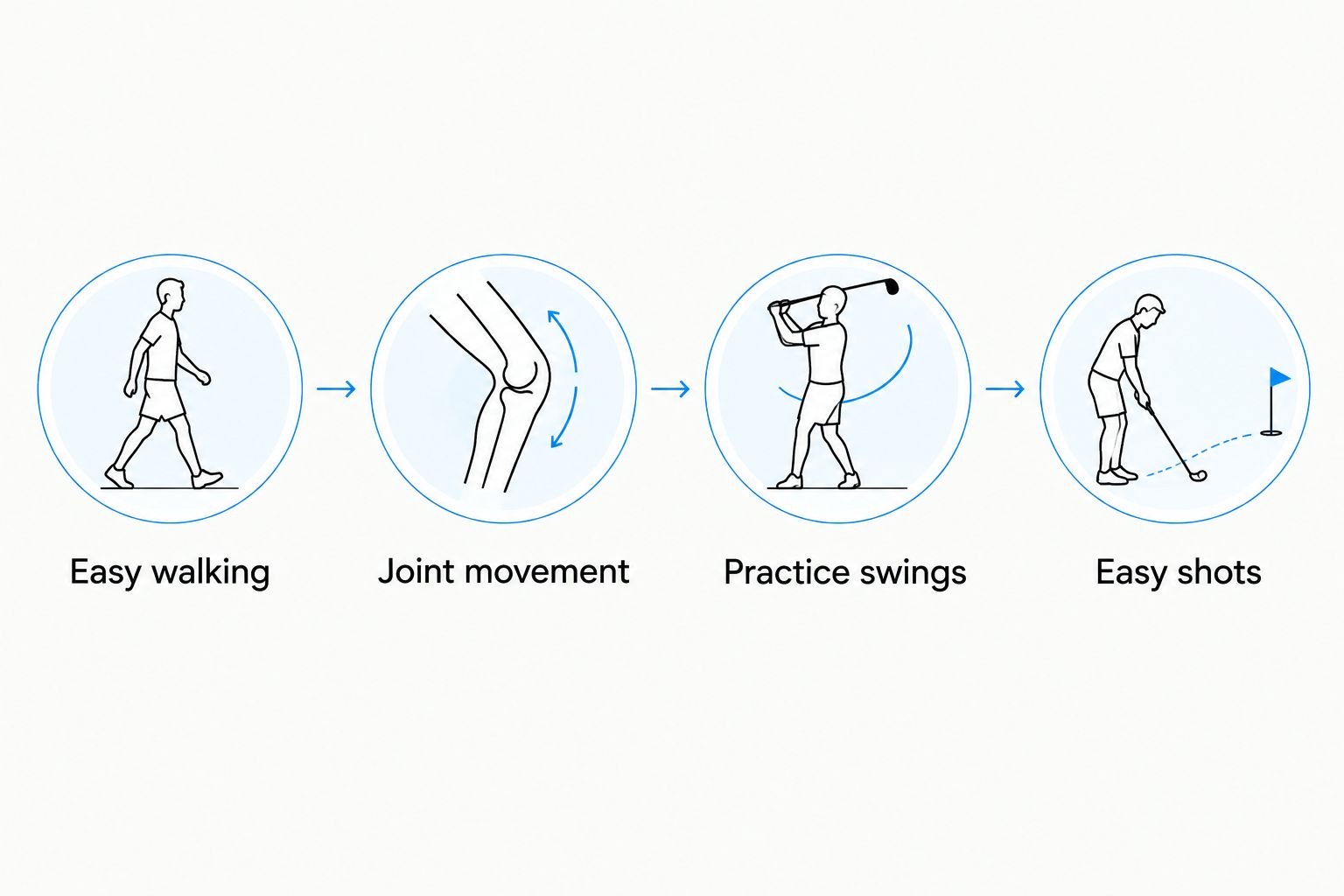
Keep the sequence familiar enough to use at the range or beside the first tee. You should not need a new exercise collection every time you play.
- Easy walking: begin with relaxed movement rather than a maximal stretch.
- Joint movement: move ankles, hips, and shoulders through comfortable ranges.
- Practice swings: rehearse smoothly without chasing backswing length.
- Easy shots: build effort gradually before full-speed attempts.
3. Choose guidance that matches the job
A handwritten exercise list is enough to start. Choose movements you understand, record the order, and repeat the session consistently. The limitation is practical: you must select the exercises, remember the cues, and decide how to adjust them.
Pliability provides daily mobility, stretching, and recovery video routines through a subscription app. It is a faster path to a guided session when selecting and sequencing movements is the barrier. Pliability is best for golfers who want guided daily mobility videos rather than building every session themselves.
Pliability mobility training is not a substitute for individual assessment or golf instruction. A video routine cannot diagnose pain or determine why your swing changes under pressure. Choose professional support when you need feedback specific to your body or technique.
- Use a written routine when you already understand the movements.
- Choose guided videos when you want demonstration and session structure.
- Work with a golf coach when the main question concerns swing technique.
- Seek clinical assessment for persistent, worsening, or unexplained pain.
- Judge the format by whether you can use it consistently and comfortably.
4. Practice hip, upper-back, and shoulder control
For a starting session, try the movements below without forcing an endpoint. The suggested repetitions are a practice template, not a performance standard. Begin with 1 set of 6 slow repetitions per side and shorten the range whenever control disappears.
For seated hip rotations, sit tall on a sturdy chair and gently move your lower leg inward and outward while keeping your thigh supported. Avoid pushing the movement with your hands. For upper-back rotation, sit upright with your arms crossed and turn comfortably without trying to hold your pelvis rigid.
For shoulder wall slides, face a wall with your forearms resting lightly against it. Slide upward only as far as you can without discomfort or a deliberate back arch. Finish with supported standing turns, using a chair for balance and allowing a natural, comfortable motion.
Keep your 2026 routine simple enough to remember. If a floor position bothers your knees or makes getting up difficult, use a seated or standing version instead of treating the floor exercise as mandatory.
- Seated hip rotations: move slowly without forcing the knee or foot.
- Seated upper-back turns: turn gently while keeping breathing relaxed.
- Shoulder wall slides: stop before you need to arch to continue.
- Supported standing turns: use light support and stay balanced.
- Comfort check: reduce range or stop when symptoms appear.
5. Separate warm-up work from longer mobility sessions
Use active, progressive movement immediately before golf. Put your more deliberate mobility practice elsewhere in the day, when you can slow down and notice how each position feels. Longer stretching is not a shortcut to being ready for your opening drive.
Start by reserving 10 minutes for a separate session on 3 days each week. This is a suggested scheduling anchor, not a proven minimum dose or a promise of results. Adjust it around your training, recovery, and tolerance.
If you use Pliability mobility training, give the session a clear place in your schedule rather than opening the app only when stiffness becomes distracting. Keep the same rule for a manual routine: consistency matters more than collecting exercises you rarely perform.
- Schedule a repeatable time after work or separate from range practice.
- Keep pre-round preparation active and specific to swinging.
- Use comfortable stretching without bouncing or forcing depth.
- Reduce the session when fatigue makes movement difficult to control.
- Leave room for strength training, golf practice, and rest.
6. Measure control instead of chasing a bigger turn
Revisit your original observations using the same positions and support. Ask whether the movement feels smoother, whether you can breathe normally, and whether you can stop and return without losing balance. Those questions are more useful than chasing an unsupported angle target.
Keep your 2026 movement notes separate from your scorecard. A better score does not prove a mobility routine worked, and a poor round does not prove it failed. Weather, decision-making, contact, and technique also affect golf performance.
If movement becomes more uncomfortable, do not respond by stretching harder. Reconsider the exercise, reduce the range, or get appropriate assessment. Progression means earning more comfortable control, not tolerating more symptoms.
- Repeat the same movement checks under similar conditions.
- Record comfort, balance, and compensations in plain language.
- Change one exercise or scheduling choice at a time.
- Keep swing-speed and scoring notes separate from mobility observations.
- Stop progressing a movement that repeatedly triggers pain.
Compare your golf mobility options
Choose the format around the problem you need to solve. Self-directed work gives you flexibility, guided videos provide structure, and individual support addresses questions a general routine cannot answer. These options serve different purposes rather than forming a simple ranking.
| Option | Best for | Main advantage | Key limitation |
|---|---|---|---|
| Self-directed routine | Golfers comfortable selecting and performing exercises | You control the exercise order and schedule | You must judge technique and make your own adjustments |
| Pliability guided routines | Golfers who want daily mobility, stretching, and recovery videos | Provides a guided session without building one yourself | General video guidance does not replace individual assessment |
| Golf coach | Golfers working on swing mechanics and practice decisions | Connects instruction directly to the golf task | Swing instruction is not medical assessment |
| Physical therapist | Golfers with persistent pain or movement concerns | Provides individual clinical assessment and guidance | Does not replace ongoing golf technique practice |
You do not need every option at once. Start with the support that answers your immediate question, then keep the mobility habit simple enough to maintain alongside it.
Common mistakes golfers make
Forcing a longer backswing
A longer turn is not a useful goal if you reach it by losing balance or moving into pain. Work within comfortable range, then let golf instruction address how that range fits your swing.
Stretching only toward the backswing side
Golf has a preferred playing direction, but your mobility routine can still explore both directions. Practice comfortable turns each way without forcing identical range or assuming that every difference needs correction.
Treating lower-back tightness as a stretching target
The location of discomfort does not tell you its cause. Do not repeatedly twist harder through a sore lower back; persistent or worsening symptoms need assessment rather than a more intense stretch.
Using a recovery session as the entire warm-up
A relaxed session after work and preparation before teeing off have different jobs. Before golf, finish with standing movement, practice swings, and progressively easier-to-harder shots rather than moving straight from passive stretching to maximum effort.
Changing the routine after every poor round
Your score is not a joint-mobility test. Keep a stable routine long enough to observe how it feels, and use golf practice or coaching to investigate contact, alignment, and shot decisions.
FAQ
What's the best mobility training for golfers?
The best starting approach combines comfortable hip rotation, upper-back movement, shoulder control, and a golf-specific warm-up. Choose exercises you can perform without forcing range, then adjust the routine to your movement needs.
Should I stretch before playing golf?
Use active, progressive movement before playing golf, then build toward practice swings and easy shots. Keep longer stretching separate from your immediate swing preparation rather than treating it as the whole warm-up.
How often should golfers do mobility training?
Start with a schedule you can repeat, such as a 10-minute session on 3 days each week. That is a planning suggestion, not a required dose; adjust it to your tolerance and other training.
Can mobility training increase my golf swing speed?
Mobility training alone does not guarantee increased swing speed. It develops movement options and control, while speed also depends on technique, strength, coordination, and practice.
Is a mobility app better than a golf coach?
A mobility app and a golf coach do different jobs. Guided videos structure movement practice, while a golf coach addresses swing technique and golf-specific decisions.
Should golfers train mobility on both sides?
Yes, practice comfortable movement in both directions even though you play golf in one preferred direction. Do not force equal range or treat every side-to-side difference as a problem.
What should I do if a golf mobility exercise hurts?
Stop the exercise rather than pushing deeper into pain. Seek qualified assessment for persistent or worsening symptoms, and stop immediately for sharp pain, tingling, or numbness.
One last thing
Do not measure success by how dramatic the stretch looks. A small standing turn you can control is a better practice target than a deep position you reach by straining. For your next 2026 session, choose one movement, perform it slowly, and finish while you still control the return.