
Physical therapists’ mobility programs are structured movement plans that combine range-of-motion work, active control, and home practice to support a patient’s functional goals. This 2026 guide explains how to build them, choose delivery tools, and separate general fitness routines from individualized rehabilitation.
- Mobility programs for physical therapists should start with a functional goal, not a stretching library.
- Pliability is best for athletes and fitness enthusiasts seeking guided mobility practice, not a substitute for individualized rehabilitation.
- Choose home exercises, stretching, and recovery routines according to assessment findings and the patient’s response.
- Track task performance and movement control alongside range of motion.
Why mobility programs matter for physical therapists
Your job is not to give every stiff joint more stretching. It is to identify the movement limitation, connect it to a meaningful task, and prescribe practice the patient can perform appropriately between visits.
That makes physical therapy different from browsing a general fitness library. You need a clear reason for each exercise, an appropriate starting position, and instructions for changing or stopping it. A daily video schedule does not make those decisions for you.
Pliability offers a subscription app with daily mobility, stretching, and recovery videos for athletes and fitness enthusiasts. Pliability is best for athletes and fitness enthusiasts seeking guided mobility practice, not a substitute for individualized rehabilitation. Treat that distinction as your starting point when considering a general mobility app.
For your 2026 program, choose the clinical plan first and the delivery format second. A printed sheet, recorded demonstration, or guided app should serve the plan—not determine it.
How to build a mobility program patients can use
1. Define the task you want to change
Start with a conversation and a practical observation. Ask what the patient wants to do, what currently gets in the way, and what a useful change would look like in everyday life or training.
Choose 1 functional task as the primary reference point. That might be reaching a shelf, getting out of a chair, or moving into a sport-specific position. The task gives your program a purpose beyond achieving a larger measurement.
Write the goal in language the patient understands. Keep your clinical interpretation in the record, but make the home instruction concrete enough that the patient knows why the movement matters.
A broad request to feel less stiff needs clarification before it becomes an exercise prescription. Ask which movement feels limited and when that limitation matters most.
- Name the task the patient wants to perform.
- Record the starting position and relevant conditions.
- Ask which part feels restricted or difficult.
- Agree on what successful practice should look like.
2. Separate available range from active control
Use your clinical assessment to distinguish the range a joint can reach from the range the patient can actively control. Flexibility and mobility overlap, but they are not interchangeable program goals.
Start manually: observe the chosen task, examine relevant movements, and document your findings. Do not use a general app’s routine selection as a replacement for assessment or as evidence of a diagnosis.
Compare like with like. If you change the setup, assistance, or measurement method, document the change rather than treating the result as a directly comparable improvement.
Choose 2 checkpoints: a repeatable movement observation and the functional task identified earlier. This keeps a joint measurement connected to what the patient actually wants to do. It also gives you a reason to reconsider the plan when one changes without the other.
- Use a consistent setup for repeat observations.
- Distinguish assisted movement from active movement.
- Note compensations relevant to the task.
- Record symptoms without assuming their cause.
- Connect assessment findings to the exercise choice.
3. Choose the delivery format after the assessment
Begin with the simplest workable format: demonstrate the prescribed movement, ask the patient to show it back, and provide written instructions. A short, individualized plan is easier to interpret than an unrestricted list of routines.
Pliability mobility videos offer an alternative delivery format for athletes and fitness enthusiasts who want guided practice. Their role is general mobility, stretching, and recovery content; the therapist still decides whether a particular routine belongs alongside the patient’s plan.
Best for guided fitness practice: an app suits someone who wants video-led sessions and can follow an appropriate routine independently. Its limitation is equally important: a general routine does not establish individual suitability or replace clinical reassessment.
For a 2026 decision, review the actual content you intend to recommend. Do not assume that a category label such as recovery means every exercise suits every stage of rehabilitation.
- Demonstrate the manual home plan first.
- Check the patient’s understanding through teach-back.
- Review any suggested video before assigning it.
- Identify movements that need modification or exclusion.
- Keep clinical instructions separate from general fitness suggestions.
4. Match the exercise to the movement goal
Choose exercises for a reason you can explain. If the goal concerns active control, the program needs an active component—not only a position held with external support.
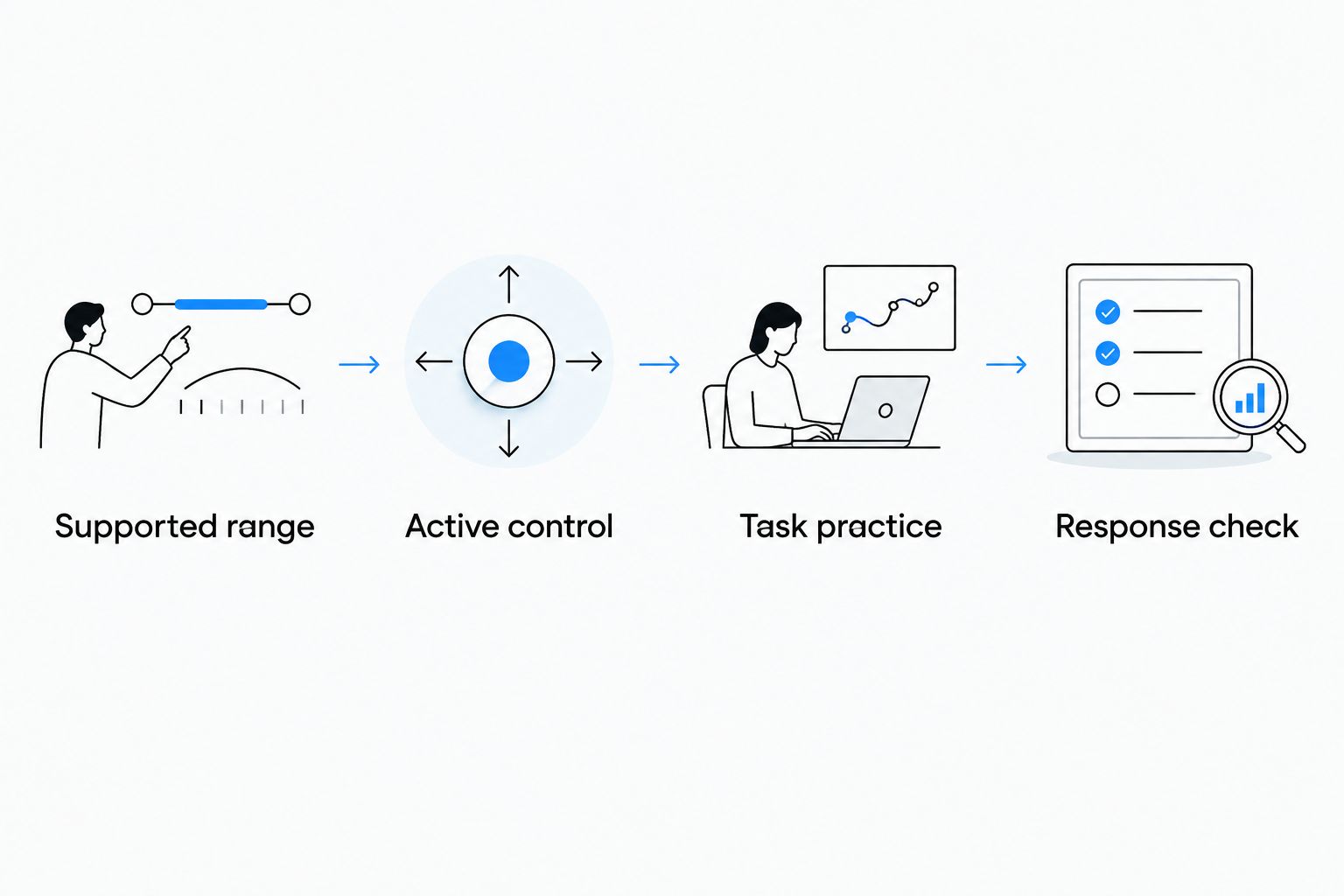
A therapist-designed sequence can include supported movement, active practice, and rehearsal of the relevant task. These are programming components, not a mandatory sequence for every patient. Select or omit each component according to your assessment.
For example, a reaching goal calls for observing how the patient reaches, not simply assigning a shoulder stretch because the shoulder feels tight. The exercise should address the finding you intend to change.
Keep the scope manageable. When you assign several movements at once, explain which one addresses which goal. Otherwise, neither you nor the patient has a clear basis for deciding what to keep.
- Supported range: select an appropriate starting position.
- Active control: practice movement without unnecessary assistance.
- Task practice: connect the movement to the patient’s goal.
- Response check: review symptoms and execution before changing difficulty.
5. Write the dose and boundaries explicitly
Set the exercise dose yourself. A routine’s total running time is not an individualized prescription, and completing a video is not the same as performing every movement appropriately.
Write the position, movement instructions, repetitions or hold duration, and planned frequency in the patient’s home plan. Select those details from the assessment rather than borrowing a universal schedule from an article.
Explain the boundaries just as clearly. Tell the patient which responses require stopping, which require contacting you, and what to do if an exercise cannot be performed as demonstrated. New or worsening symptoms need clinical review, not an instruction to stretch harder.
Include a fallback version when appropriate. A patient who cannot use the original position needs a clear alternative or a clear instruction to pause—not permission to improvise through pain.
- Specify the starting position and movement cues.
- Prescribe the dose in unambiguous units.
- State the acceptable response for that individual.
- Define stop and contact instructions.
- Explain what to do when the planned version is unsuitable.
6. Fit practice around the patient’s actual week
Ask when and where the patient intends to practice. Check floor access, available support, equipment, confidence, and competing training commitments before you finalize the plan.
An athlete’s mobility work also needs a defined place within the wider training schedule. Establish whether the session is preparation for activity, separate movement practice, or part of a recovery habit. Those purposes are not interchangeable.
Pliability mobility routines provide daily video content, but a daily content schedule is not a clinical requirement to complete a session every day. Your prescription sets the schedule for rehabilitation-related practice.
For your 2026 home-program template, include a realistic practice window and a fallback instruction. Make the plan usable on an ordinary day, not only on a day with unlimited time and energy.
- Identify a practical location for the exercises.
- Check equipment and position requirements.
- Place practice within the existing weekly schedule.
- Distinguish rehabilitation exercises from optional fitness content.
- Agree on what to do after a missed session.
7. Reassess before you add more
Use a simple paper log first. Ask the patient to record whether practice happened, how the movement felt, and what changed in the target task. A more elaborate system only earns its place if it helps you make decisions.
Use 3 tracking fields: completion, response, and task performance. These are documentation prompts, not a validated outcome measure. Add the clinical measures appropriate to your assessment separately.
At review, repeat the original checkpoints under comparable conditions. Progress, simplify, replace, or stop an exercise according to the findings. Do not increase difficulty simply because the patient has finished the current set of videos.
Your 2026 review process should distinguish participation from results. Completing the plan tells you about participation; it does not, by itself, establish that the movement goal has improved.
- Record completion without treating it as an outcome.
- Review symptoms during and after practice.
- Repeat the chosen movement observation.
- Recheck the functional task.
- Document the reason for each program change.
Compare mobility-program delivery options
Choose the format that supports the clinical task. Individualized instructions offer specificity; general video content offers guided practice. Neither removes the need to decide what the patient should perform.
| Option | Best for | Main advantage | Key limitation |
|---|---|---|---|
| Therapist-written home plan | Individualized exercise instructions | Records the exact movements, dose, and boundaries you prescribe | Written cues cannot show movement unless supplemented |
| Therapist-recorded demonstration | Patients who need to revisit their prescribed technique | Shows the selected setup and execution | A recording does not observe the patient’s later performance |
| Pliability | Athletes and fitness enthusiasts seeking guided mobility, stretching, and recovery | Provides daily video routines in a subscription app | General fitness content does not replace individual assessment or rehabilitation planning |
| Supervised physical therapy session | Assessment, feedback, and exercise adjustment | Allows observation and modification during practice | Does not provide supervision between appointments |
A combined approach needs clear roles. The individualized plan defines the rehabilitation work; optional general fitness content belongs alongside it only when appropriate. Avoid giving conflicting instructions across formats.
Common mistakes physical therapists make with mobility programs
Treating every restriction as a stretching problem
A report of tightness does not tell you which intervention to select. Assess the relevant task and movement before deciding whether the program needs range work, active control, another approach, or further evaluation.
Correct it: write the finding each exercise addresses. Remove exercises that have no clear connection to the assessment or goal.
Assigning an entire library instead of a plan
Access to many routines leaves the patient with another decision to make. It also obscures which movements you prescribed and which the patient selected independently.
Correct it: identify the approved content, the intended purpose, and any exclusions. Keep the patient’s clinical instructions easy to find.
Measuring range without checking the task
A different measurement does not automatically establish better performance in reaching, squatting, or another meaningful activity. The task needs its own review.
Correct it: revisit the original functional goal alongside your movement measures. Explain when the findings do not yet support changing the plan.
Calling every session recovery
Recovery is too broad to describe the clinical purpose of an exercise. The label does not explain what the patient should do, how much to perform, or which responses require attention.
Correct it: name the session’s purpose and prescribe its boundaries. Keep general recovery habits distinct from individualized rehabilitation instructions.
FAQ
What are mobility programs for physical therapists?
Mobility programs for physical therapists are structured movement plans based on assessment findings and functional goals. They can include range-of-motion exercises, active control, task practice, and instructions for home use.
What’s the best mobility program for a physical therapy patient?
The best mobility program is the one matched to the patient’s assessment, goals, and response. Choose the exercises and boundaries before choosing a delivery app or video library.
Can physical therapists recommend Pliability?
Physical therapists can consider Pliability as general guided fitness content when its routines fit the individual’s needs. Pliability offers daily mobility, stretching, and recovery videos; those videos do not replace an individualized rehabilitation plan.
Is stretching the same as mobility training?
Stretching and mobility training are not identical. Stretching focuses on flexibility, while a mobility program can also include active movement control and practice connected to a functional task.
Should patients do mobility exercises every day?
Exercise frequency should follow the individual prescription, not an app’s publishing schedule. The therapist should specify frequency, dose, and when the patient needs to stop or request review.
How do physical therapists track mobility progress?
Physical therapists track mobility progress through repeatable movement measures and the patient’s functional task. Exercise completion and symptom reports add context but do not replace reassessment.
What should a patient do if a mobility exercise hurts?
The patient should stop an exercise that causes pain outside the limits established by the treating clinician and follow the agreed contact instructions. New or worsening symptoms require clinical review rather than a harder stretch.
One last thing
Write the reassessment plan before you assign the first exercise. If you cannot explain what you will recheck, the program’s purpose is not clear enough yet.
Put that rule in your 2026 template: name the task, record the starting point, and define the review. Then choose the simplest delivery method that supports those decisions.