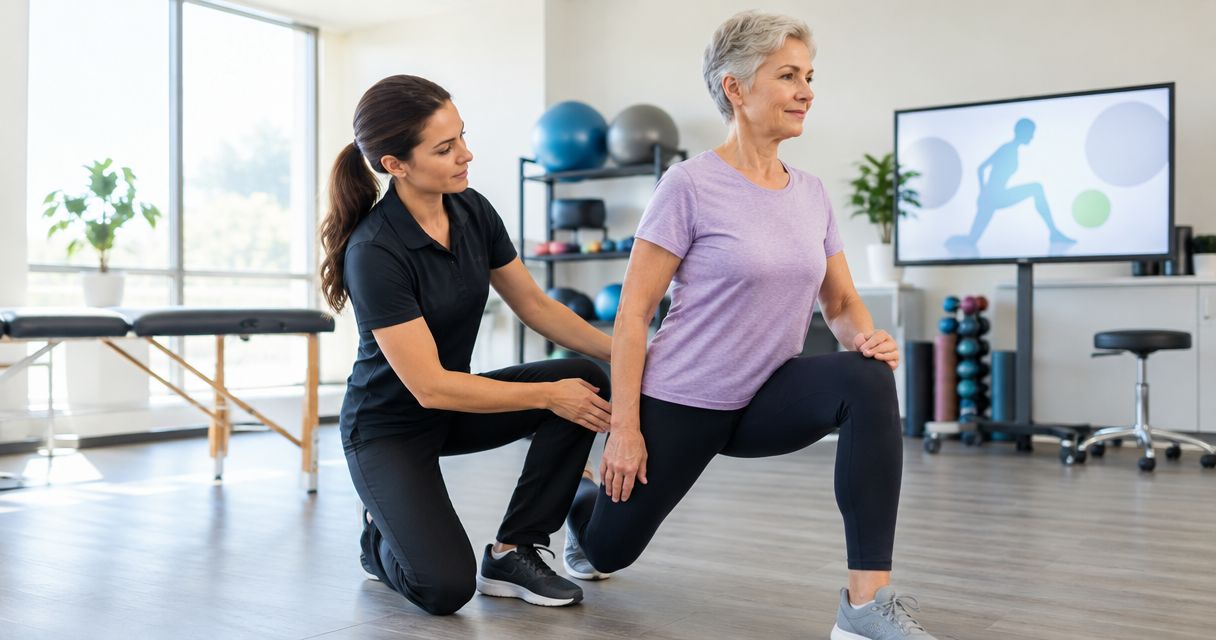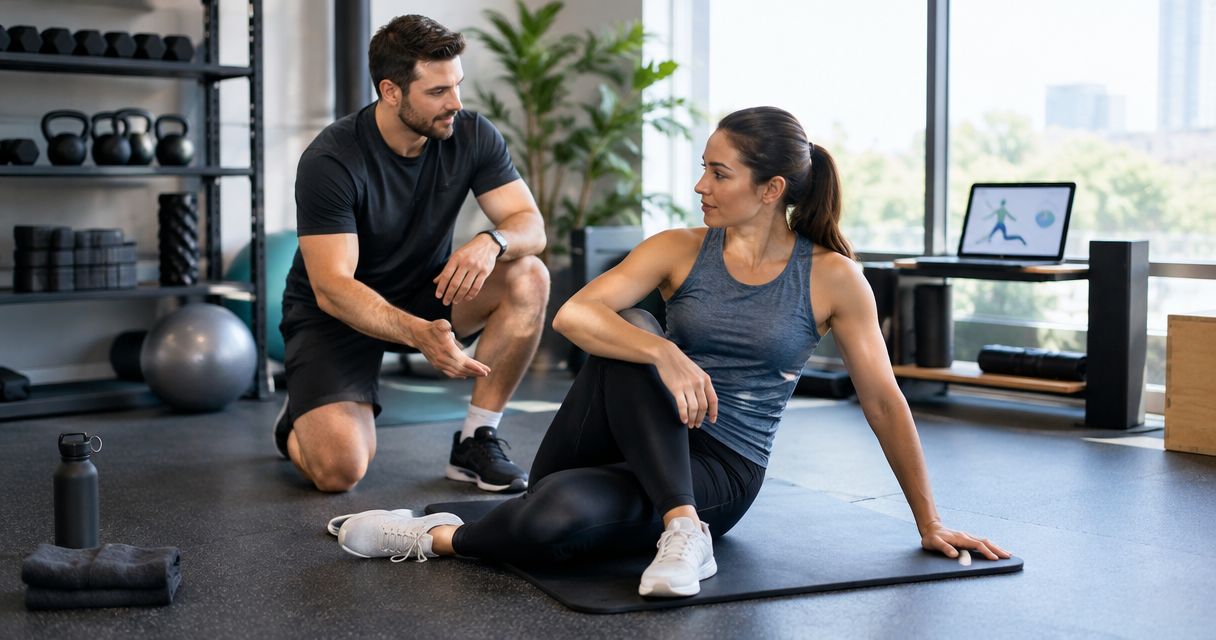
Personal trainers’ mobility coaching is the practice of teaching usable joint movement with the aim of helping clients perform their training tasks with greater control. This 2026 guide shows you how to assess movement, choose drills, and support practice between sessions without turning a fitness session into a clinical assessment.
- Mobility coaching for personal trainers should connect range of motion to a specific training task, not chase flexibility alone.
- Pliability suits athletes and fitness enthusiasts who want guided daily mobility practice between coached sessions.
- Use movement checks, simple exercise progressions, and repeatable observations to guide your coaching.
- Refer pain and injury concerns to a qualified healthcare professional rather than prescribing more stretching.
Why mobility coaching matters for personal trainers
Your client needs movement they can use during training. A deeper passive stretch does not, by itself, demonstrate control in a squat, overhead reach, or running stride. Coach the task, not just the stretch.
Personal trainers also have a delivery problem: you see the client during appointments, but independent practice happens without your immediate feedback. Instructions must be clear enough to repeat and specific enough to review. For clients unfamiliar with guided routines, this guide to mobility apps for beginners provides a starting point for comparing formats.
Build your 2026 service around a simple distinction: fitness coaching develops movement skills and exercise habits; clinical assessment investigates symptoms and injury. Stay within your qualifications. A client describing pain needs a different decision from a client asking how to practice a comfortable movement.
The business value is a clearer service, not a promised result. You can explain what you are coaching, why the client is practicing it, and what you will review at the next appointment.
Build your 2026 mobility coaching workflow
1. Define the movement your client needs
Start with the client’s goal and the exercise where movement feels restricted. Ask what they want to do, what they currently avoid, and whether the limitation involves discomfort, uncertainty, or lack of control. These are different coaching conversations.
For a client struggling with a squat, the useful question is not simply whether their hips feel tight. Ask where the movement becomes difficult and observe the whole task. Do not label a joint as the cause from a single repetition.
Write one practical objective in the client’s own terms. For example, working toward a comfortable squat variation gives your coaching a clearer direction than improving mobility everywhere. It also helps you explain why a particular drill belongs in the session.
- Name the training task the client wants to improve.
- Ask about pain, injury history, and professional guidance.
- Record what the client notices during the movement.
- Choose a version they can perform comfortably.
2. Establish a repeatable movement check
Use observation before equipment. A comfortable squat, overhead reach, or supported ankle movement can give you a baseline for coaching, provided you treat it as an observation rather than a diagnosis.
Standardize the setup. Footwear, stance, support, and instructions affect what you see. If you change everything at the next appointment, you cannot make a useful comparison. Video is optional; obtain consent before recording and follow your privacy obligations.
Record movement quality as well as range. Note whether the client needs support, changes position, or loses control. A single pass-or-fail score hides those details. Avoid interpreting a left-to-right difference as evidence of injury or as an automatic reason to stop training.
- Repeat the same setup at each review.
- Use the same instructions and viewing angle.
- Record comfortable range and visible compensations.
- Note symptoms without assigning a diagnosis.
- Stop checks that provoke pain.
3. Choose the smallest useful practice plan
Begin with a written routine you can demonstrate yourself. Select movements that connect to the client’s task and give each one a clear purpose. More exercises create more instructions; they do not automatically create a better plan.
For example, schedule a 5-minute practice slot with 2 movements as a starting template, not a universal prescription. Adjust the work to the client’s comfort, ability, and schedule. The aim is repeatable practice, not reaching a target duration at any cost.
When a client wants video guidance between appointments, Pliability offers subscription-based daily mobility, stretching, and recovery routines. That provides an alternative to repeatedly demonstrating every home session yourself. You still decide whether a routine fits the client’s needs.
Pliability is best for athletes and fitness enthusiasts who want guided daily mobility practice between coached sessions. It does not replace your observation or a clinician’s assessment.
- Start with movements the client can repeat independently.
- Explain what each movement supports.
- Demonstrate a comfortable version before progressing it.
- Give clear instructions for stopping or modifying.
- Choose video guidance only when it suits the client.
4. Teach control before adding difficulty
Show the movement, watch the client repeat it, and correct the most relevant issue. Keep the instruction short. A client trying to remember several cues at once has less attention available for the movement itself.
Separate available range from control. A client might reach a position with assistance but struggle to hold or move through it independently. That difference gives you a coaching focus; it does not establish a medical explanation.
Use support when it makes practice clearer. A wall, chair, or stable handhold can reduce the demands of balance while the client learns the intended movement. Remove support only when doing so serves the exercise objective, not because unsupported movement looks more advanced.
- Demonstrate the movement from a useful viewing angle.
- Give one clear cue at a time.
- Ask the client to describe where they feel effort.
- Reduce range when control breaks down.
- Add difficulty only while execution remains comfortable.

5. Connect the drill to strength training
Mobility work needs a job inside the session. After a drill, return to an appropriate version of the training task and observe how the client moves. Do not assume that a stronger stretching sensation means a better exercise outcome.
For squat coaching, compare a comfortable squat before and after the chosen preparation. Keep the setup consistent. If nothing useful changes, reconsider the drill, the instructions, or the exercise variation rather than automatically adding more stretching.
Strength work and mobility practice are not competing categories. Your program can include both, with exercise selection matched to the client’s current abilities. Avoid claiming that one drill fixes a movement pattern or prevents injury. Observe what happens and make the next coaching decision from that information.
- Name the exercise the drill prepares the client for.
- Recheck the task using the original setup.
- Keep useful preparation and remove irrelevant additions.
- Select strength variations the client controls.
- Avoid treating an immediate change as a permanent result.
6. Make independent practice easy to follow
Agree on when and where the client will practice. A routine attached to a specific part of their day is easier to explain and review than an open-ended instruction to stretch more.
Use a simple written note first: movement, setup, cue, and stopping instruction. Ask the client to demonstrate the routine before leaving. That reveals misunderstandings while you can still correct them.
A guided video routine offers structure, but it also introduces another choice: which session should the client follow? Set boundaries instead of handing over an app and hoping the right practice happens. Keep communication clear about what you review during appointments and what requires professional medical advice.
- Choose a realistic practice opportunity together.
- Write down the agreed movements and cues.
- Ask the client to demonstrate the plan back.
- Record completed practice without judging missed sessions.
- Review whether the format suits the client.
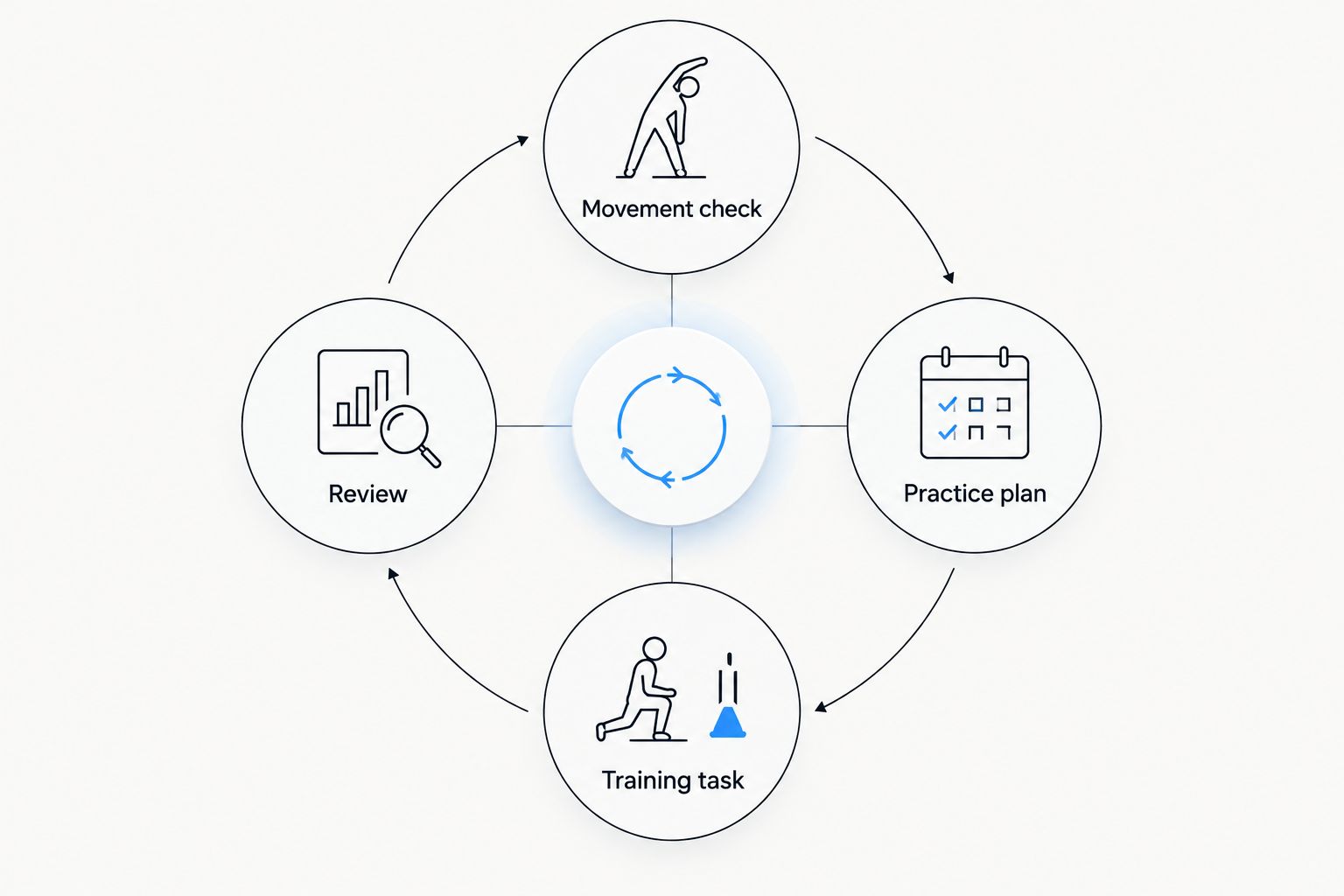
7. Review the task and adjust the plan
Choose a review point when you assign the routine. An example is a check-in after 1 week of practice; this is an administrative choice, not a promised timeline for physical improvement.
Review what the client actually did before interpreting the outcome. A plan that was unclear or impractical needs a delivery change before it needs harder exercises. Ask about comfort, confidence, and the training task, not just stretching intensity.
Progress one element at a time so you can explain the change. That might mean adjusting support, range, or exercise complexity. If pain appears or symptoms worsen, stop the provoking activity and direct the client toward an appropriately qualified healthcare professional.
- Repeat the original movement check.
- Ask which instructions were difficult to follow.
- Compare control as well as available range.
- Change one element of the plan at a time.
- Record the reason for continuing, changing, or referring.
The review process is a loop, not a ladder toward ever harder stretches. A simpler routine that supports the client’s training remains a valid choice.
Compare mobility coaching options for 2026
Choose the delivery method around the client’s need for instruction and feedback. Video guidance and live observation solve different problems. Neither should be presented as a substitute for clinical care when symptoms need assessment.
| Option | Best for | Practical strength | Key limitation |
|---|---|---|---|
| Trainer-written routine | Clients comfortable practicing independently | Connects instructions directly to your coaching | Requires you to demonstrate and maintain the plan |
| Live personal training | Clients who need real-time movement feedback | Lets you observe and adjust execution | Feedback is limited to the time you spend together |
| Pliability subscription app | Athletes and fitness enthusiasts wanting guided daily mobility practice | Provides mobility, stretching, and recovery video routines | Video guidance does not provide your live observation |
| Qualified healthcare professional | Clients whose pain or injury concerns need clinical assessment | Addresses questions outside fitness coaching scope | Clinical care serves a different purpose from ongoing personal training |
A mixed approach is useful when each part has a clear role. You coach the training task, the client follows an agreed practice plan, and a clinician handles concerns outside your scope. Avoid adding a platform simply to make the service look more elaborate.
Common mistakes personal trainers make
Treating every restriction as tightness
A difficult movement does not identify its cause. Balance demands, task familiarity, positioning, and available range all deserve observation. Describe what you see before naming what you think is wrong. A limitation is not a diagnosis.
Assigning a routine without teaching it
Sending instructions is not the same as confirming understanding. Watch the client perform the selected movements and explain the stopping rules. If the routine requires repeated clarification, simplify it before assigning more work.
Measuring only how far the client moves
Extra range is not the only useful observation. Record whether the client controls the movement, needs less support, or performs the chosen exercise more comfortably. Do not force a deeper position merely to improve a recorded result.
Letting mobility work displace the actual goal
A warm-up can grow until it consumes the session. Keep each drill accountable to a training task or an agreed practice objective. Remove exercises that have no clear role rather than preserving them out of habit.
Selling certainty you cannot support
Do not promise to correct posture, remove pain, prevent injury, or produce a specific result by a deadline. Explain your process instead: observe, teach, practice, and review. That gives the client a clear expectation without making a clinical or performance guarantee.
FAQ
What is mobility coaching for personal trainers?
Mobility coaching for personal trainers teaches clients to access and control movement needed for their training tasks. It combines observation, exercise instruction, independent practice, and review without diagnosing medical conditions.
What’s the difference between mobility coaching and stretching?
Mobility coaching addresses how a client uses and controls movement, while stretching focuses on lengthening muscles and other soft tissues. Stretching can be part of a mobility plan, but a stretch alone does not demonstrate control during exercise.
What’s the best way to start mobility coaching in 2026?
Start with a comfortable training task the client wants to improve. Record a repeatable baseline, teach a small practice plan, and agree on when you will review it.
Is Pliability a replacement for a personal trainer?
Pliability provides guided mobility, stretching, and recovery video routines rather than replacing a personal trainer’s live observation. Use it for independent practice when the routines fit the client’s goals and abilities.
How long should a client’s mobility routine take?
Set the routine length around the client’s needs, tolerance, and schedule rather than a universal duration. Begin with a manageable plan and review whether the client can follow it comfortably and consistently.
Should personal trainers stretch clients who report pain?
Do not use stretching as an automatic response to pain. Stop the provoking activity, stay within your qualifications, and direct the client to an appropriately qualified healthcare professional when symptoms require assessment.
How do I know whether mobility coaching is helping?
Repeat the original training task under the same conditions and compare movement control, comfortable range, and the client’s experience. Review practice completion too, and do not treat an immediate change as proof of a lasting improvement.
One last thing
The deepest position is not always the best coaching result. A client who uses the same range with better control has given you something useful to record, even when the movement does not look more dramatic.
For your next 2026 program review, write the training task beside every mobility drill. If you cannot explain the connection, reconsider the drill. Keep the practice purposeful. Give the client something they understand and can repeat.