No—it is not too late to improve flexibility as an adult. Adults can increase their range of motion with regular stretching and movement practice, including later in life. The limit is not a birthday: your joint health, injury history, and consistency shape what you can safely improve, and stretching should never mean forcing through pain.
- Is it too late to improve flexibility as an adult? No. Regular practice can improve adult range of motion.
- Pliability suits athletes who want guided daily mobility, stretching, and recovery routines.
- Combine flexibility work with controlled movement; reaching farther is different from controlling that range.
- Stop for sharp pain, tingling, or numbness. Those symptoms are not a signal to stretch harder.
Is it too late to improve flexibility as an adult?
No. Flexibility remains trainable in adulthood, but your progress does not need to look like someone else's. You can work toward a more comfortable squat, easier overhead reach, or less restricted movement without chasing a split or touching your toes.
Start with a movement you actually need. Reaching a shelf and getting into a running stride demand different ranges, so a useful plan targets the restriction rather than collecting stretches. If you need help choosing a format, this guide to mobility apps for beginners explains the options.
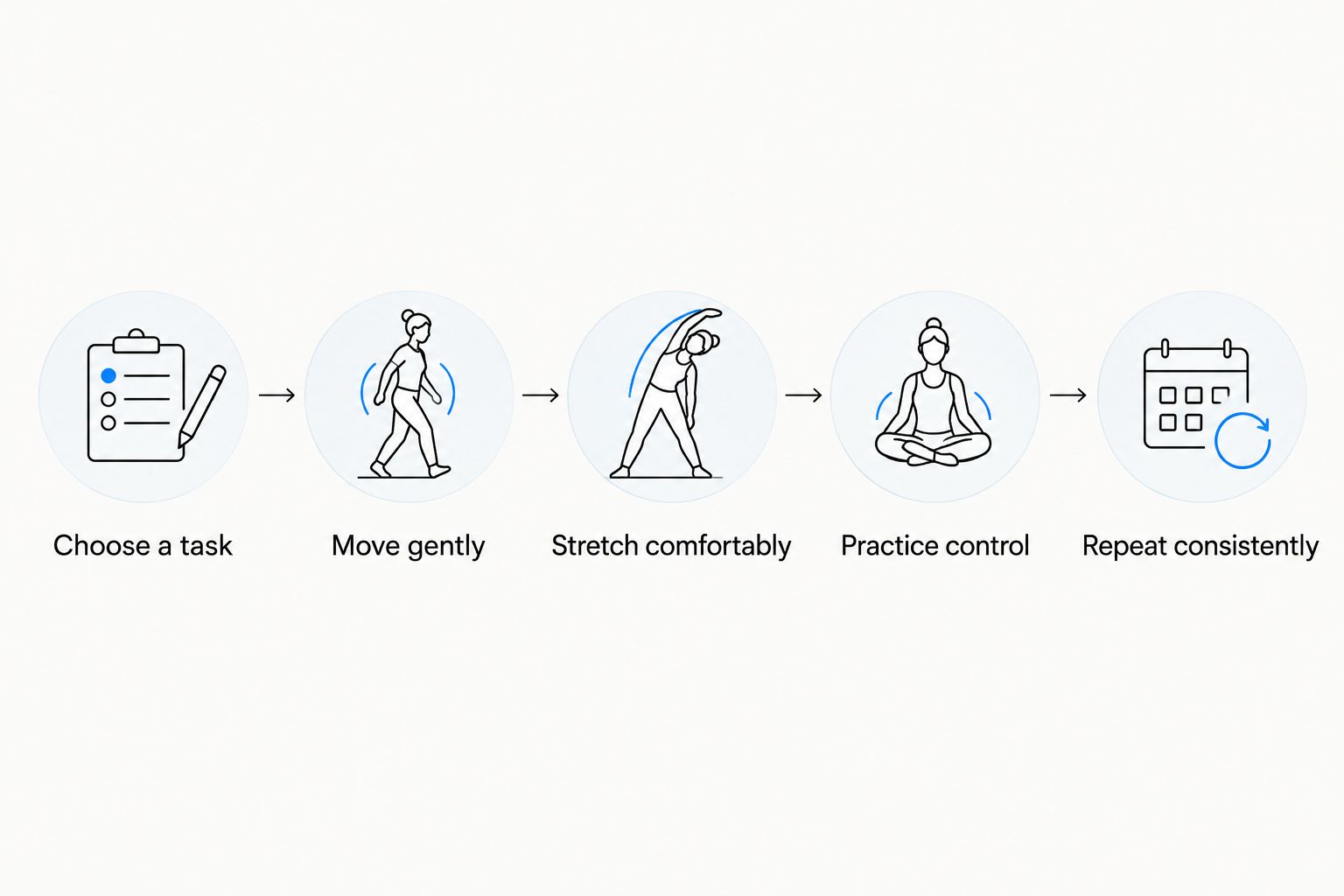
Use this sequence for your 2026 starting plan:
- Choose a task. Identify a movement that feels restricted but does not cause pain.
- Move gently. Walk or use easy, controlled movements before stretching.
- Stretch comfortably. Find mild tension without bouncing or holding your breath.
- Practice control. Move actively through the range you can manage without compensating.
- Repeat consistently. Revisit the same movement under similar conditions to judge change.
You do not need an extreme starting position. You need a repeatable position that lets you breathe normally and stay in control.
Why this matters
Adult flexibility is often treated as a pass-or-fail test: either you can fold forward easily or you are permanently stiff. That framing misses the point. Useful flexibility supports the movements you want to perform, not a universal shape everyone must achieve.
Flexibility and mobility also describe different things. Flexibility concerns available range; mobility includes your ability to actively control movement through that range. A stretch can help you access a position without teaching you to use it under load.
For your 2026 training, judge the work by function. An easier reach, a smoother squat, or a more comfortable stride is a better target than copying the most flexible person in the room.
Which approach should you use?
Stretching and strength work serve different purposes. Use the method that matches the task instead of expecting one stretch to solve every restriction.
| Approach | Best for | What it does | Main limitation |
|---|---|---|---|
| Static stretching | Focused flexibility practice | Holds a comfortable position near the end of your available range | Does not, by itself, train active control or strength |
| Dynamic movement | Preparing for an activity | Moves repeatedly through a controlled range | Can become rushed, turning movement into momentum |
| Strength through range | Building control in usable positions | Trains muscular effort through a manageable range | Requires suitable technique and loading; more depth is not automatically better |
Static stretching is not a substitute for strength training. Dynamic movement is not a contest to swing a limb farther. Strength work should challenge the range you control, not pull you into a position you cannot manage.
You can include these approaches in the same training week. Their roles matter more than giving one method a permanent winner's label.
How should you start stretching in 2026?
The American College of Sports Medicine's exercise-prescription guidance recommends flexibility work at least 2–3 days per week, with static stretches generally held for 10–30 seconds and repeated 2–4 times. These are general exercise guidelines, not an individualized prescription or a deadline for results.
Start with a small selection of movements that fit your needs. Use a comfortable position, keep breathing, and reduce the range if you need to brace hard or twist elsewhere to stay there.
Choose a task
Pick something you want to do more comfortably: reach overhead, bend to put on shoes, or lower into a squat. Describe the restriction plainly. Knowing what you want to change makes your practice easier to assess.
Do not use a painful movement as a daily test of determination. Pain changes the decision from choosing a stretch to understanding why the movement hurts.
Move gently
Begin with easy movement rather than forcing a cold, stiff position. Walking and controlled movements of the joints you plan to train provide a practical transition into the session.
Keep the preparation comfortable. You are getting ready to move, not trying to exhaust yourself before the flexibility work begins.
Stretch comfortably
Ease into mild tension and hold without bouncing. You should be able to breathe normally and leave the position under your own control.
If you feel pinching inside a joint, back out. A stronger sensation is not proof that you have found a more effective stretch.
Practice control
After stretching, explore the available range actively. Move slowly enough to notice when you begin arching your back, rotating your pelvis, or shifting your weight to avoid the intended movement.
Use support where needed. Holding a stable surface can make a movement easier to control without turning balance into the main challenge.
Repeat consistently
Attach the practice to an existing habit, such as finishing a workout or taking a break from your desk. Choose a setup you can repeat without rearranging your day.
Record the movement and how it feels. Keep the comparison conditions similar so you do not mistake a different warm-up or body position for a lasting change.
Why adult flexibility progress varies
Age is part of the picture, not the entire explanation. These factors help explain why two adults following similar routines do not necessarily gain the same range:
- Starting range. Your current movement establishes the baseline. Someone who already has substantial flexibility is working from a different starting point.
- Practice consistency. Repeating suitable exercises gives you a clearer basis for progress than switching routines whenever a session feels difficult.
- Joint structure. Anatomy influences available movement. Not every restriction is a muscle that needs a harder stretch.
- Injury and surgery history. Previously injured or surgically repaired areas can require specific precautions and individualized rehabilitation guidance.
- Strength and control. Accessing a position with assistance differs from moving into it actively and supporting yourself there.
- Symptoms and health conditions. Pain, inflammation, and conditions affecting joints or nerves change what exercise is appropriate.
Do not respond to every plateau by increasing intensity. First check whether your exercise matches the restriction and whether your technique has changed.
If the movement remains limited or painful, a physical therapist can assess the problem. That is more useful than repeatedly guessing which tissue feels tight.
How do you know your flexibility is improving?
Choose a reference movement you can repeat safely. Use the same setup and notice both range and control: whether you can reach farther, move more smoothly, or perform the task with less compensation.
Touching your toes is an imperfect universal score. Body proportions and technique affect the result, and reaching lower by rounding your back does not isolate a change in hamstring flexibility.
For your 2026 progress notes, describe the task rather than awarding yourself a flexibility grade. Write down whether your heels stay grounded during a comfortable squat or whether an overhead reach requires less back arching.
Temporary changes after warming up are useful, but they are not the same as a lasting change in your baseline. Compare like with like, and avoid repeatedly pushing to your maximum just to see whether the session worked.
When should you stop stretching and get help?
Sharp pain, numbness, tingling, and a joint that feels unstable are reasons to stop—not instructions to push deeper. Stretching should not reproduce symptoms that travel down an arm or leg.
Seek assessment for persistent pain, unexplained loss of movement, swelling, or a restriction that follows an injury. A sudden, substantial change in movement deserves attention rather than another stretching routine.
If you have had surgery or have a diagnosed joint condition, follow your clinician's exercise restrictions. General flexibility guidance does not replace an individual rehabilitation plan.
People who already have unusually large ranges also need a different emphasis. If you feel loose but lack control, pursuing more passive range is not automatically the right goal; strength and stability deserve attention.
Where does a guided mobility app fit?
Pliability is best for athletes who want guided daily mobility routines. The subscription app provides mobility, stretching, and recovery videos for athletes and fitness enthusiasts, including HYROX competitors and teams.
The practical benefit of Pliability is having a guided format for your mobility practice. The limitation is equally clear: a video routine cannot establish why a particular joint hurts or replace a physical examination.
Use a guided routine to support a suitable habit. Stop or modify a movement that produces concerning symptoms instead of treating completion as the goal.
Can I improve flexibility if I have always been stiff?
Yes—being stiff for years does not establish that your range is fixed. Start with movements you can perform comfortably and give yourself a consistent practice rather than testing your deepest position every day.
Longstanding restriction still deserves context. If a joint feels blocked, painful, or markedly different from the other side, get it assessed instead of assuming the answer is more stretching.
How long does it take to become more flexible as an adult?
There is no single deadline for becoming more flexible as an adult. The answer depends on your starting range, the movement you are training, your practice, and any underlying limitations.
Use the ACSM frequency of 2–3 days per week as general scheduling guidance, not a promise of results by a particular date. Track the task you care about and adjust the plan when practice is not helping.
FAQ
Is it too late to improve flexibility as an adult in 2026?
No. Adults can improve flexibility with regular practice, including later in life. Joint health, injury history, and the movement you want to improve help determine an appropriate plan.
Can I become more flexible if I cannot touch my toes?
Yes. Not touching your toes does not mean your flexibility is fixed, and the test is influenced by body proportions and technique. Work on comfortable movement rather than forcing your fingertips toward the floor.
How often should an adult stretch?
The American College of Sports Medicine recommends flexibility work at least 2–3 days per week. Choose exercises suited to your needs and follow individualized guidance if you have an injury or medical condition.
How long should I hold a stretch?
ACSM guidance generally recommends static holds of 10–30 seconds, repeated 2–4 times. Stay within comfortable tension and stop for sharp pain, tingling, or numbness.
Should stretching hurt if I want to improve?
No. Pain is not a requirement for improving flexibility. Reduce the range or stop if you feel sharp pain, joint pinching, numbness, or tingling.
Is stretching better than strength training for mobility?
Neither replaces the other. Stretching addresses available range, while strength training can build control through a manageable range; the right balance depends on your goal.
Can Pliability help me start a mobility habit?
Pliability provides guided daily mobility, stretching, and recovery video routines for athletes and fitness enthusiasts. It offers a format for practice, but it does not replace assessment of pain or injury.
One last thing
The deepest position is not always the most useful position. Range you can enter, control, and leave comfortably matters more than a photograph of your maximum stretch.
Choose a movement you want to improve, make the practice repeatable, and watch what changes. You are not trying to recover someone else's flexibility. You are building movement you can use.