
No—mobility exercises cannot replace physical therapy when you need an assessment, injury rehabilitation, or a plan tailored to a medical condition. They can support everyday movement and complement prescribed rehabilitation, but a general routine cannot determine why you hurt or which activities are safe for your injury. In 2026, choose between them by the problem you need to solve—not by how similar the exercises look.
- Can mobility exercises replace physical therapy? No—not when you need assessment, individualized rehabilitation, or postoperative guidance.
- Mobility training supports everyday movement; physical therapy addresses assessed movement problems and functional limitations.
- Pliability is best for athletes and fitness enthusiasts seeking guided mobility practice, not individualized injury rehabilitation.
- Combine stretching and recovery routines with physical therapy only when they fit your prescribed plan.
Can mobility exercises replace physical therapy?
Mobility exercises are a training tool. Physical therapy is a clinical service that can include that tool. The overlap does not make them interchangeable. A physical therapist evaluates your symptoms, movement, and functional limitations, then selects and adjusts treatment around those findings.
A general routine starts with movements to follow. Physical therapy starts with a person to assess. That distinction matters when pain, weakness, injury, or a change in function drives your decision.
For more on that overlap, see the guide to mobility programs for physical therapists. The central question is whether an exercise fits your current rehabilitation goals—not whether it carries a mobility label.
| Approach | Best for | Main benefit | Main limitation |
|---|---|---|---|
| General mobility exercises | People seeking everyday movement practice without an injury-specific treatment need | A repeatable way to practice movement and stretching | No individual clinical assessment or injury-specific progression |
| Physical therapy | People with pain, injury, postoperative restrictions, or reduced function needing assessment | Treatment selected and adjusted around clinical findings and functional goals | Requires participation and practice; attendance alone does not restore function |
| Therapist-prescribed home exercises | People carrying out an assessed rehabilitation plan between appointments | Practice tied to specific rehabilitation needs | Requires clear instructions and review when symptoms or ability change |
The same movement can appear in all three approaches. Its purpose, dosage, and progression are what distinguish general practice from treatment.
Why this matters
A stiff ankle after sitting and a swollen ankle after a fall are not the same problem. Both might make a squat feel restricted. They do not justify the same response.
If you treat every restriction as something to stretch, you miss the reason it exists. Pain, swelling, joint restrictions, and reduced strength can all affect movement. Feeling tight does not establish which factor is responsible.
The reverse mistake is treating all movement as dangerous once something hurts. Rehabilitation often includes exercise, but the selection and progression depend on the condition. The goal is appropriate movement—not maximum stretching and not automatic rest.
When mobility exercises fit
Mobility practice fits a general movement goal: exploring comfortable range, practicing control, or building a consistent stretching habit. You do not need to turn every instance of ordinary stiffness into a rehabilitation project.
Start with the task you want to improve. Perhaps you want to move more comfortably after desk work or maintain movement practice alongside training. That gives your routine a purpose without pretending you have diagnosed a restriction.
Useful signs that you are choosing general practice rather than treating an injury include:
- You are working toward a movement or training goal rather than managing an unexplained symptom.
- You can perform the movements comfortably without forcing the position.
- You have no injury-related or postoperative restrictions that conflict with the routine.
- You are willing to stop and seek advice if pain or function changes.
The benefit is repeatability. The limitation is uncertainty: a follow-along routine cannot explain a painful restriction, check your neurological function, or decide whether an injury needs further investigation.
Use mobility to practice movement. Do not use it to label pain as harmless. A familiar stretch is not evidence that a new symptom has a familiar cause.
When physical therapy is the better next step
Physical therapy is the better next step when you need someone to assess a movement problem and guide rehabilitation. Examples include pain that repeatedly interrupts activity, difficulty returning to a sport after injury, or uncertainty about how to exercise within surgical restrictions.
A therapist can assess more than flexibility. Depending on your symptoms, an evaluation can include strength, balance, sensation, movement tolerance, and the tasks you need to perform. Treatment can then address the findings instead of assuming that every limitation needs more range.
Describe what has changed in practical terms. Can you no longer climb stairs comfortably? Does your shoulder stop you from dressing? Does a recurring symptom interrupt running? These details help connect treatment to function.
Physical therapy also has limits. It cannot promise a particular recovery date, and a treatment plan needs your participation outside appointments. Some symptoms require medical assessment beyond physical therapy; an exercise session is not the right starting point for every problem.
When should I seek urgent medical care instead of stretching?
Seek urgent medical care for a major injury, an obvious deformity, or a sudden inability to bear weight after trauma. New or progressive weakness also needs prompt medical assessment rather than a trial of mobility exercises.
New loss of bladder or bowel control, numbness around the groin or saddle area, or severe back pain with these symptoms requires emergency assessment. Do not wait to see whether a stretching routine changes it.
Why the right approach varies
The choice between general mobility practice and clinical rehabilitation depends on your situation. These factors change what is appropriate:
- Reason for restriction: Everyday stiffness, a recent injury, and postoperative limitations require different decisions.
- Symptom behavior: A comfortable movement and one that produces increasing pain should not receive the same progression.
- Functional impact: Difficulty walking, dressing, working, or training gives the problem more significance than an isolated flexibility goal.
- Medical restrictions: Surgery and some health conditions place limits on movement or loading that a general routine does not account for.
- Capacity beyond flexibility: Strength, balance, and tolerance for activity can limit function even when a joint has adequate range.
- Response over time: A plan needs review when symptoms worsen, new symptoms appear, or function declines.
These are reasons to individualize the decision—not reasons to diagnose yourself from a checklist. When the cause is unclear, describe the symptoms and seek an assessment.
How to combine mobility exercises with physical therapy
Your rehabilitation plan sets the boundaries. Additional mobility work must fit inside them. More exercise is not automatically better, particularly when several routines target the same sensitive area.
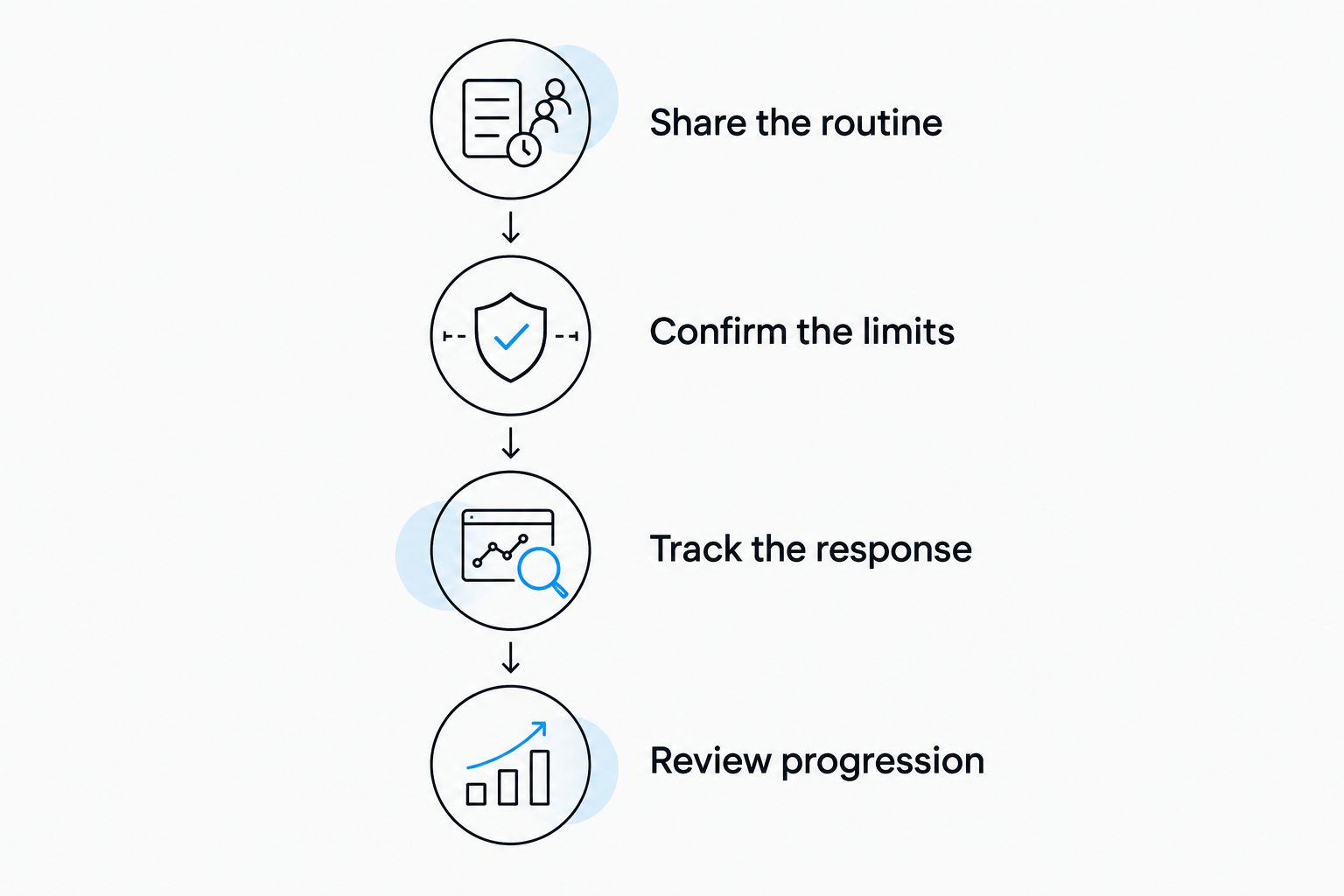
Use this sequence before adding a general session to prescribed rehabilitation.
1. Share the routine
Show your therapist the movements you want to add. A routine's name does not reveal its positions, loading, or demands, so share the actual exercise instructions or video.
Mention the rest of your training too. A stretching session does not happen in isolation from lifting, running, work, or sport. Your therapist needs that context to judge the addition.
2. Confirm the limits
Ask which movements are appropriate, which need modification, and which should wait. Get clear instructions about range, effort, and symptom response instead of assuming that a deeper position means better progress.
If a restriction comes from your surgeon or another treating clinician, do not use a general routine to work around it. Confirm how that restriction applies to the movements you want to perform.
3. Track the response
Notice how you feel during the session and how you function afterward. Report increasing pain, swelling, new symptoms, or reduced ability to perform ordinary tasks.
Give useful descriptions rather than just saying an exercise felt bad. Name the movement, the symptom location, and what changed afterward. That information helps your therapist adjust the plan.
4. Review progression
Ask when and how to change the exercise. Progression can involve resistance, control, balance, or a return to a specific task—not simply a longer hold or a deeper stretch.
A home program can remain useful between appointments or after discharge. Its role depends on the plan you were given, not on whether you are currently attending a clinic.
Where a mobility app fits in your 2026 training plan
Pliability is best for athletes and fitness enthusiasts seeking guided mobility practice, not individualized injury rehabilitation. The subscription app provides daily mobility, stretching, and recovery video routines, including routines for HYROX competitors and teams.
That format gives you movements to follow and a structure for regular practice. It does not replace an examination, identify the cause of pain, or establish postoperative restrictions.
Use Pliability for its stated purpose: guided mobility, stretching, and recovery practice. If you are receiving treatment, ask your therapist whether the specific routine fits your plan before adding it.
The practical advantage is guidance without having to assemble every session yourself. The boundary is equally clear: a general video routine is not an individualized treatment decision.
Can I do mobility exercises instead of my prescribed exercises?
No—do not substitute a general mobility routine for prescribed rehabilitation exercises without discussing the change with your therapist. The prescribed movements can target strength, balance, or activity tolerance that stretching does not address.
If the home program feels too difficult, too easy, or hard to fit into your day, say so. Ask which exercises take priority and how to modify the plan rather than replacing it with something unrelated.
Do I still need physical therapy if stretching makes me feel better?
Feeling better after stretching does not establish that the underlying problem has resolved. A temporary change in comfort is different from restored strength, function, or readiness for sport.
Discuss the improvement with your therapist and connect it to your goals. The useful question is whether you can safely perform the activities you need—not just whether a stretch feels relieving.
Can home exercises replace physical therapy appointments?
Home exercises can be part of physical therapy, but they do not automatically replace assessment or follow-up. The appropriate balance depends on your condition, progress, and treatment plan.
Ask what you should manage independently and what changes require review. Being able to perform an exercise alone is not the same as knowing when to progress it.
FAQ
Can mobility exercises replace physical therapy in 2026?
No. Mobility exercises can support general movement and complement rehabilitation, but they do not replace clinical assessment or an individualized treatment plan when those are needed.
Is mobility training the same as physical therapy?
No. Mobility training practices movement and range of motion; physical therapy assesses and treats movement problems and functional limitations, sometimes using mobility exercises.
Should I stretch a painful joint?
Do not force a painful joint into a stretch. Stop movements that increase pain and seek an assessment when pain persists, follows an injury, or limits ordinary activity.
Can Pliability help me follow a mobility routine?
Pliability provides daily mobility, stretching, and recovery video routines for athletes and fitness enthusiasts. It is a guided practice option, not a substitute for injury assessment or individualized rehabilitation.
Should I stop physical therapy once I feel more flexible?
Do not use flexibility alone to decide when to stop physical therapy. Discuss your functional goals, symptoms, strength, and remaining limitations with your therapist.
What should I ask before adding a mobility app to rehabilitation?
Ask your therapist whether the specific movements fit your treatment plan. Confirm any restrictions, modifications, and symptom changes that mean you should stop or seek review.
Is soreness proof that mobility exercises are working?
No. Soreness does not prove that an exercise is appropriate or effective; judge your routine against its goal and the symptom guidance in your treatment plan.
One last thing
The missing piece is not always more flexibility. If you can reach a position but cannot control it, tolerate load there, or use it in your sport, stretching deeper does not address every part of the task.
For your 2026 training plan, write down the activity you want back before choosing the exercise. Walking comfortably, reaching overhead, and returning to running are clearer goals than simply becoming less tight. Let that goal guide the next conversation—and the next session.