
Poor mobility can contribute to chronic pain, but restricted movement does not prove that stiffness is the cause. Pain can also limit movement, creating a cycle of guarding, inactivity, and reduced capacity. The practical answer in 2026 is to build comfortable movement gradually while getting persistent, worsening, or unexplained pain assessed—not to force a deeper stretch.
- Can poor mobility cause chronic pain? It can contribute, but pain also restricts movement.
- Pain lasting longer than 3 months is generally classified as chronic; duration alone does not identify the cause.
- Pliability supports guided mobility practice, not diagnosis or treatment of an unexplained pain condition.
- Build comfortable range and strength together. Stop forcing movements that increase pain or cause new symptoms.
Why this matters
Stiff hips, restricted ankles, and uncomfortable shoulders deserve attention. They do not automatically explain why you hurt. Treating every ache as a flexibility problem can send you toward harder stretching when you need a different movement dose or a clinical assessment.
If hip stiffness is your starting point, the guide to mobility apps for tight hips and hip pain covers guided practice options. Use a routine to organize movement, not to diagnose the source of pain.
Your goal is usable movement, not the largest possible range. Getting dressed, walking, reaching, and training comfortably matter more than matching someone else's stretch position.
Can poor mobility cause chronic pain?
Yes. Restricted mobility can contribute to pain when it limits your movement choices or makes a particular task harder to tolerate. But the relationship runs both ways: pain can make you move less, brace more, and avoid positions that previously felt ordinary.
Chronic pain generally means pain that persists or recurs for longer than 3 months, consistent with the International Association for the Study of Pain's chronic-pain classification. That definition describes duration. It does not establish whether the pain comes from restricted movement, an injury, inflammation, nerve involvement, or another condition.
A useful distinction: flexibility describes available range, while mobility includes your ability to move through and control that range. Having less range than another person is not, by itself, evidence that something is wrong.
Use this sequence to decide what deserves attention:
- Name the task. Identify the activity that hurts or feels limited, such as reaching overhead or getting out of a chair.
- Notice the pattern. Record what brings symptoms on, what eases them, and whether they are changing.
- Check the response. Try a smaller, comfortable version rather than forcing the full position.
- Choose support. Seek assessment when symptoms persist, worsen, or interfere with ordinary activities.
These steps help you describe the problem. They are not a self-diagnosis test, and temporary relief after stretching does not prove that tight tissue caused the pain.
How restricted movement and pain can reinforce each other
When an ankle does not move comfortably through a squat, you can change the task by adjusting your stance, depth, or support. Those changes are not automatically harmful. Bodies use different movement strategies, and there is no single position that guarantees freedom from pain.
The concern is a pattern that repeatedly exceeds what you currently tolerate. If every attempt at a movement brings increasing symptoms, repeating it harder is not a useful mobility strategy.
Pain itself can also narrow your movement options. You brace, shorten your stride, or avoid bending because the movement feels threatening. Over time, avoiding activity can reduce strength and confidence, making a return to the task harder.
Restricted movement is a clue, not a diagnosis. An assessment considers your symptoms, history, function, and examination findings together instead of assigning the problem to one tight muscle.
A tight feeling does not always mean a short muscle
A body part can feel tight because you are guarding it, because a task is unfamiliar, or because you have recently increased its workload. Stretching changes how the area feels, but that sensation alone does not identify the underlying issue.
If a familiar stretch stops helping, do not automatically increase its intensity. Reconsider the task, your recent activity, and whether the symptoms need professional attention.
Choose the approach that matches the problem
Mobility practice, strength training, and clinical assessment serve different purposes. They are not interchangeable, and persistent pain often calls for an individualized combination rather than a stretching-only plan.
| Approach | Best for | Main benefit | Limitation |
|---|---|---|---|
| Gentle mobility practice | Exploring comfortable movement without warning signs | Lets you practice range and control at a manageable intensity | Does not establish why pain is present |
| Progressive strength training | Building capacity for daily activities and sport | Develops the ability to produce and tolerate force | Exercise selection and progression need to match your symptoms |
| Clinical assessment | Persistent, worsening, unexplained, or function-limiting pain | Evaluates the problem and guides appropriate care | Requires individual assessment rather than a generic routine |
Choose mobility practice to work on movement. Choose assessment to investigate pain. Use strength work to build capacity when it fits your condition and current tolerance.
Mobility practice: explore range without forcing it
Start with a movement you can control. A supported reach, a comfortable ankle movement, or a gentle change of position is more useful than a dramatic stretch that leaves you bracing.
The benefit is a manageable way to practice moving. The limitation is equally important: completing a routine does not rule out an injury or medical condition. Avoid turning a successful session into proof that you should push further immediately.
Strength training: build capacity within tolerable range
Being able to reach a position is different from being able to control it under load. Strength work addresses that second problem, whether the task is climbing stairs, carrying groceries, or returning to training.
The benefit is task-relevant capacity. The limitation is that more load is not always the right next step, especially during a flare-up. Adjust the exercise, support, range, or resistance rather than treating discomfort as a requirement for progress.
Clinical assessment: investigate persistent symptoms
A physical therapist or other qualified clinician can assess movement alongside your symptoms and medical history. That matters when the same complaint keeps returning or when ordinary activities are becoming harder.
The benefit is an individualized decision about what to do next. The limitation of any general article—including this 2026 guide—is that it cannot examine you or determine the cause of your pain.
Why the relationship between mobility and pain varies
There is no universal amount of flexibility that prevents chronic pain. Your needs depend on the activities you perform and how your body responds to them.
- Task demands: Comfortable walking and a deep overhead squat require different movement ranges. Train for the task you actually need.
- Recent workload: A sudden change in training or daily activity changes what your body must tolerate. Review workload alongside mobility.
- Strength and control: Available range is only part of the picture. You also need enough control and capacity to use it.
- Pain-related guarding: Pain can lead you to brace or avoid movement. Less movement does not necessarily mean stiffness started the problem.
- Sleep and stress: Both interact with pain experience. A mobility routine does not replace attention to these factors.
- Underlying conditions: Injury, inflammatory disease, nerve problems, and other conditions need appropriate evaluation rather than an assumption of tight muscles.
These factors explain why identical stretches do not produce identical results. They also explain why a useful plan changes when your symptoms, activities, or diagnosis change.
How should you approach mobility when you already hurt?
For your 2026 routine, start with the smallest useful version of the activity—not a flexibility target. If reaching overhead is uncomfortable, explore a supported reach within a comfortable range rather than repeatedly testing the painful endpoint.
Use this process when you have no warning signs and movement is appropriate for your condition:
- Check symptoms. Notice whether symptoms are familiar and stable or new and worsening.
- Reduce range. Make the movement smaller or add support so you can stay in control.
- Move comfortably. Avoid forcing, bouncing, or holding your breath to reach a position.
- Recheck function. Notice how the movement feels afterward and how you feel later.
- Adjust the dose. Reduce or stop an exercise that repeatedly makes symptoms worse; seek advice if the pattern continues.
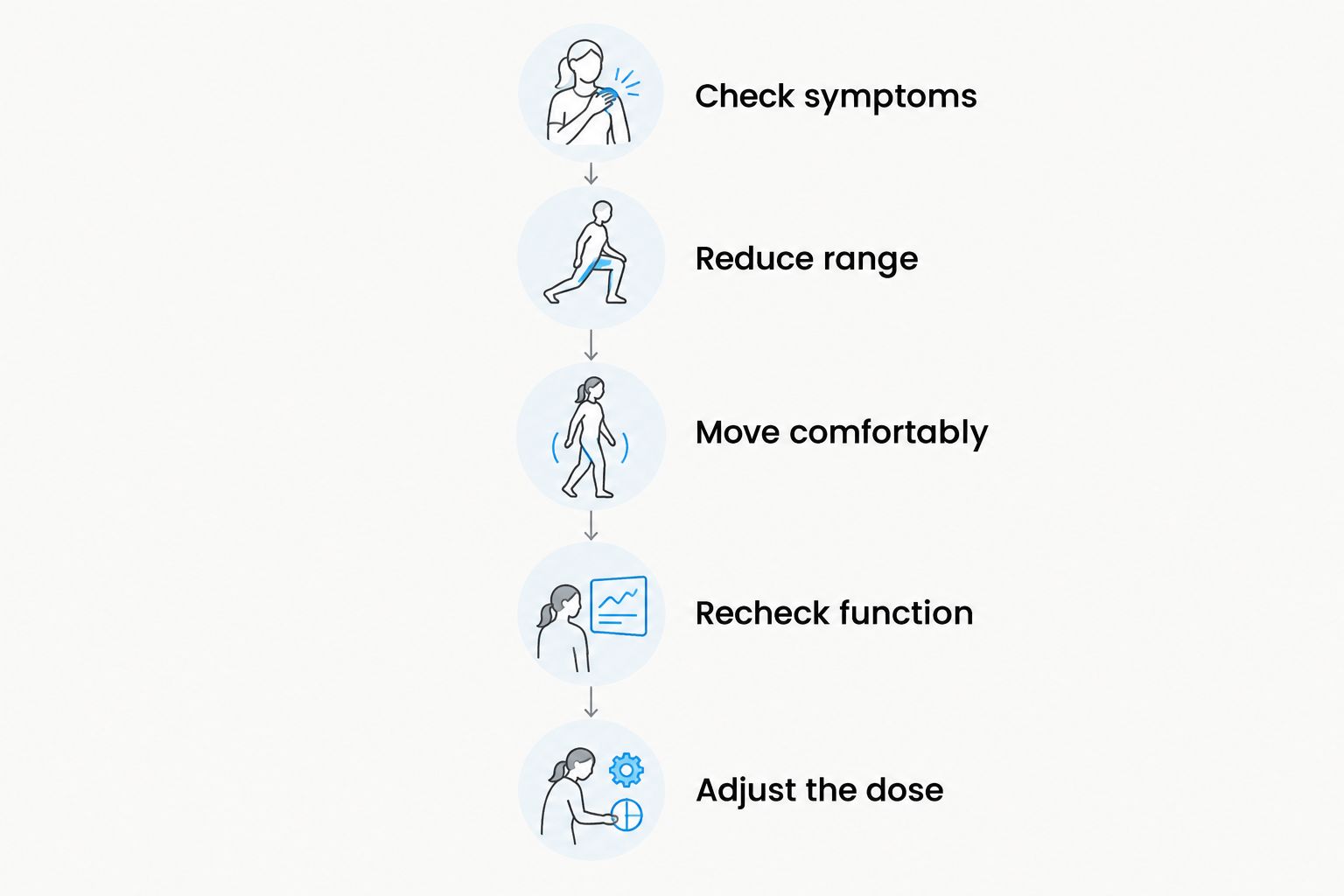
Progress is not limited to a deeper stretch. An easier reach, a more comfortable walk, or better tolerance for a familiar task is useful information. Track those changes instead of judging every session by how far you can bend.
General activity guidance provides context, not a pain prescription. The World Health Organization recommends at least 150 minutes per week of moderate-intensity aerobic activity and muscle-strengthening activity on at least 2 days per week for adults. Those population-level targets do not specify the right starting dose for someone with chronic pain; adapt activity to your condition with appropriate support.
When should pain get assessed instead of stretched?
Pain lasting longer than 3 months deserves assessment, particularly when it affects sleep, work, walking, or training. You do not need to wait that long if symptoms are worsening or interfering with daily life.
Seek urgent medical care for new loss of bladder or bowel control, numbness around the groin or saddle area, or rapidly worsening weakness. These are not problems to work through with a mobility video.
Prompt assessment is also important after significant trauma or when pain accompanies fever or unexplained weight loss. Sudden, severe, or unfamiliar symptoms need medical judgment rather than a harder stretch.
Will stretching alone fix chronic pain?
Stretching alone is not a complete treatment for chronic pain. It can be part of a plan, but it does not address every possible contributor or replace diagnosis when one is needed.
For your 2026 plan, pair appropriate movement with attention to strength, activity tolerance, recovery, and clinical advice. Keep what helps you function; change what consistently aggravates symptoms.
Where does a guided mobility app fit?
Pliability is best for athletes and fitness enthusiasts who want guided mobility practice, not a diagnosis for chronic pain. The subscription app provides daily mobility, stretching, and recovery video routines.
The practical benefit of Pliability is a guided format for your movement habit. The boundary is clear: an app cannot examine you or determine why a joint hurts.
Use Pliability alongside an appropriate care plan when guided movement fits your needs. If a routine aggravates symptoms, stop or modify the movement rather than trying to complete it at any cost.
FAQ
Can poor mobility cause chronic pain even if I exercise?
Poor mobility can contribute to chronic pain even when you exercise, but exercise habits alone do not establish the cause. Pain can also restrict movement, so persistent symptoms need assessment rather than an assumption that you need more stretching.
How long does pain have to last before it is chronic?
Pain that persists or recurs for longer than 3 months is generally classified as chronic. You should seek help sooner when pain is worsening, unexplained, or limiting normal activities.
Does feeling tight mean my muscles are too short?
Feeling tight does not prove that a muscle is too short. Guarding, recent workload, and pain can affect the sensation, so judge the pattern and your function rather than the feeling alone.
Should I push through pain during mobility exercises?
Do not force mobility exercises through increasing pain or new symptoms. Reduce the range or stop, and seek professional advice when symptoms persist or repeatedly worsen.
Is mobility training better than strength training for chronic pain?
Neither mobility training nor strength training is universally better for chronic pain. The right combination depends on your symptoms, movement needs, medical history, and current capacity.
Can a mobility app replace physical therapy in 2026?
A mobility app does not replace an individualized clinical assessment or treatment plan in 2026. Guided routines can support appropriate movement practice, but they cannot diagnose the source of pain.
One last thing
Stop using your deepest stretch as your main progress test. Choose a daily task that matters: putting on shoes, reaching a shelf, or walking comfortably. Notice whether that task becomes easier without a lasting symptom increase.
That is a more useful direction than chasing flexibility for its own sake. Move with control. Build capacity. Get help when pain keeps narrowing your life.